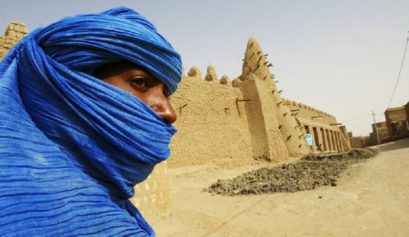
It is what conservators, archivists and researchers have feared. As Malian troops, supported by the French military, advanced on the fabled city of Timbuktu in northern Mali, retreating Islamist rebels have set fire to the Ahmed Baba Institute and a warehouse containing valuable scientific manuscripts dating back to medieval times.
The Ahmed Baba Institute housed an estimated 30,000 manuscripts. The texts include documents on astronomy, medicine, botany, mathematics and biology, evidence that science was under way in Africa before European settlers arrived. They were not only from scholars working in Timbuktu, once a center for learning, but also from all over Mali and as far as the borders of Mauritania, Burkina Faso, Senegal, Guinea, Niger, Algeria and the Ivory Coast.
It is unclear at this stage how many of the texts have been destroyed.
The rebel group Ansar al Din wrestled control of Timbuktu from Tuareg separatists in April last year, and since have been using the Institute as their base. The rebels had earlier looted the building of its vehicles, computers and other equipment.
“There is no way these people can claim to be Africans when they destroy the very foundation of our contribution to world knowledge and academia,” says George Abungu, vice president of the executive council of the International Council of Museums. The texts “are the very evidence that Africa had a rich academic history before the coming of the Europeans, as opposed to the earlier notion that we had none,” he says. He describes the burning as “an incredible loss to Africa’s heritage, a backward move to the dark ages”.
Read more: NewScientist