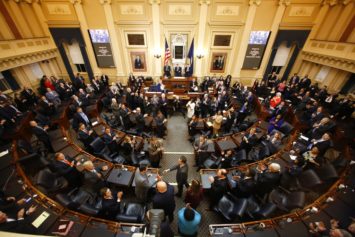
As the U.S. Supreme Court prepares to tackle the issue of gay marriage, recent trends indicate that the country is on the verge of major transformation on this issue, with nine states on the East and West Coasts allowing same-sex marriage and Illinois possibly about to become the second state in the Midwest to allow it.
In the wake of the November election, Illinois Democrats are about to have a so-called “super majority” in both Houses of the Illinois state legislature.
Chicago state Senator Heather Steans will introduce a gay marriage proposal next week, according to Rikeesha Phelon, spokeswoman for Illinois Senate President John Cullerton.
“The Senate president and Senator Steans are confident they have the votes to pass a same-sex marriage bill,” Phelon told the Chicago Tribune.
If passed, it would make Illinois the 10th state to legalize same-sex marriage.
This movement comes as CNN talk show host Piers Morgan created more controversy during an interview with faith leader Rick Warren by suggesting the Bible needs to be rewritten.
“Both the Bible and the Constitution were well intentioned but they are basically, inherently flawed. Hence, the need to amend it,” Morgan said while interviewing Pastor Warren on his CNN show.
“Not a chance,” Warren said. “What I believe is flawed is human opinion, because it constantly changes.”
“But you and I know the Bible is, in many places, a flawed document,” Morgan continued. “My point to you about gay rights for example—it’s time for an amendment to the Bible. You should compile a new Bible.”
When Morgan called for a rewriting of the “flawed” U.S. Constitution to take away gun ownership rights, it prompted a petition drive on the White House petition site to have him deported back to the UK—garnering more than 84,000 signatures so far.
But as a piece in the Christian Science Monitor pointed out, it is in the U.S. military where the same-sex marriage laws are the most difficult to justify—and which would see the biggest change if the U.S. Supreme Court struck down the Defense of Marriage Act that declares a spouse can only be of the opposite sex, a provision that has already been declared unconstitutional by 8 federal courts.
Even when gay couples are legally married under state law, the Defense of Marriage Act (DOMA) forbids the US government from treating such military couples as married, which denies the partner such benefits as housing, medical care, and survivor benefits should they die while serving their country. The Monitor story chronicles the case of Chief Warrant Officer Charlie Morgan, who has terminal breast cancer and is concerned that her surviving spouse won’t be entitled to the same benefits as a heterosexual spouse when she dies.
There is an “exhaustive list” of benefits that same-sex spouses do not receive, Zeke Stokes, spokesman for OutServe-Servicemembers Legal Defense Network, an advocacy organization in Washington, told the Monitor.
For example, because the military doesn’t allow same-sex spouses to live off-base with their partners, one is forced to live on base while the other lives off-base, incurring the expense of two households. In addition, same-sex spouses aren’t allowed to shop in the base grocery store.
Stokes recounted the story of a same-sex spouse who had permission from the base command to shop at the commissary, but only to buy items for the child she had with her partner. So when she went shopping, she had to justify each item and tell the cashier why it was specifically for her child.
“Those sorts of things can sometimes be as psychologically damaging as not having health care,” he says. “Because it’s so publicly humiliating.”
Morgan said she and her partner Karen and their daughter Casey had a similar experience on a recent “bucket list” vacation in Hawaii.
“I had my ID card, and Casey had hers, but Karen was told she couldn’t go in. Karen does all the shopping for our family, and Casey was asking, ‘Mama, why can’t Mommy come?’ ” Morgan says. “It was embarrassing – plus, as the caretaker in our family, Karen is the one who knows what we like to eat, not me.”