After women in Swaziland, a small nation in southern Africa, held a march last month to protest a spate of rapes, police came up with a novel solution: to make it illegal for women to wear miniskirts, stomach-baring tops and low-rise jeans.
Women who break the new law face a fine of up to $10 and a six-month jail term if they don’t pay the fine. More than 60 percent of the population lives on less than $1.25 a day.
“The act of the rapist is made easy, because it would be easy to remove the half-cloth worn by the women,” police spokeswoman Wendy Hleta was quoted as saying in the Independent Online news.
“They will be arrested,” she said.
Accrording to Hleta, if a woman is raped while wearing revealing clothing, then she is responsible for the assault.
“I have read from the social networks that men and even other women have a tendency of ‘undressing people with their eyes’. That becomes easier when the clothes are hugging or are more revealing,” Hleta said.
The ban derives from an 1889 colonial law that had not been enforced recently, but police wanted to alert women about its existence after receiving complaints from some men in the city of Manzini about women wearing mini-skirts.
The Swaziland ban is part of the nation’s effort to curb its mind-boggling rate of HIV infection—a rate so high that the United National Development Program has said that if it continues unabated the “longer term existence of Swaziland as a country will be seriously threatened.” According the Kaiser Family Foundation, 26.1 percent of adults and more than 50 percent of adults in their 20s are infected with HIV, the highest rate in the world. As a result, Swaziland, one of the world’s poorest nations, also has the lowest life expectancy at 31.88 years.
In 2000, the government introduced a law requiring school girls aged 10 and above to wear knee-length skirts to curb promiscuity as part of its attempts to halt the spread of AIDS.
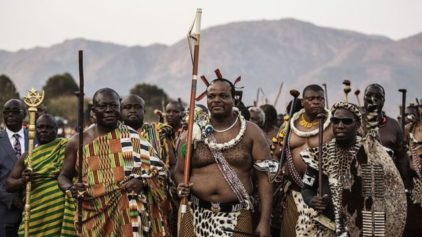
Published reports say the ban on revealing clothing won’t apply to the costumes worn by young women during ceremonies like the annual Reed Dance, where King Mswati chooses a wife. The king, who already has 13 wives, chooses from a line of young bare-breasted virgins wearing beaded skirts that cover their front but barely cover their behinds—and they aren’t allowed to wear underwear.
King Mswati is the last absolute monarch in Africa. His country of 1.2 million people is almost completely surrounded by South Africa, which is its primary trading partner and on whose economy Swaziland is almost totally dependent.