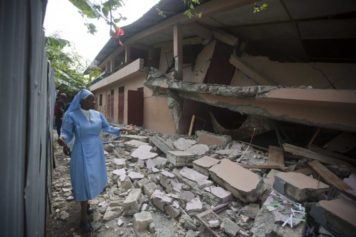
The most impoverished nation in the Western Hemisphere is pleading for international help even as much of the world’s attention is focused on the devastation dealt to the United States by Hurricane Sandy.
The storm, a powerful Category Two hurricane when it tore through Haiti last Thursday, killing more than 50 people, destroying crops and homes and crippling transportation in the Caribbean nation.
“I am launching an appeal to international solidarity to come help the population, to help support the completion of our efforts towards saving lives and property,” Haitian Prime Minister Laurent Lamothe was quoted as saying Wednesday evening during a cabinet meeting rebroadcast on local media.
Two new deaths were recorded in Haiti, bringing the total for the country to 54, said Marie Alta Jean-Baptiste, director of the country’s Civil Protection agency. That means the toll for the Caribbean as a whole is now 71.
Hurricane Sandy drenched the country’s south with more than 20 inches of rain in 24 hours. President Michel Martelly has declared a month-long state of emergency.
Haitian authorities were able to revise the death toll as the rivers receded, allowing officials to travel through the storm-drenched southern peninsula. The death toll had been 52. Jean-Baptiste said Wednesday that one of the new deaths occurred during a mudslide and the other was a person who drowned trying to cross a rain-swollen river. There are still 21 people unaccounted for after the storm.
According to statistics presented during the meeting, the agricultural sector registered a loss of more than $104 million.
“Several thousand kilometers of agricultural roads were destroyed and thousands of heads of cattle were swept away by the flood waters, which also destroyed thousands of hectares of plantations,” Agriculture Minister Jacques Thomas said.
Health Minister Florence Guillaume said “numerous cases” of cholera have also been reported in the wake of the storm.
Cholera can spread quickly in contaminated water, and has killed more than 7,000 Haitians and sickened hundreds of thousands others since an outbreak began in October 2010.
“What we’ve just heard is frightening. We should act quickly for the people and put ourselves to work to improve the situation,” Lamothe said. “Without a doubt we don’t have enough means, but we must show we have the will,” he added, reiterating his call for international support.
On Thursday, the government communication bureau indicated that Venezuela has proposed building 5,000 homes and had already sent three planes and a boat loaded with 240 tons of food.
France has promised to rebuild seven destroyed bridges, while Mexico has offered food.
Haiti is still rebuilding after the massive 2010 earthquake that leveled much of the capital, left hundreds of thousands homeless and killed more than 200,000 people. Many of the 370,000 people still displaced by the earthquake are in search for shelter.
In the Bahamas, the total cost of damage to private property and public infrastructure is expected to reach as high as $300 million, according to a report from the Caribbean Catastrophe Risk Insurance Facility, a risk pool for 16 governments in the Caribbean.
That total would be higher than last year’s Hurricane Irene, which caused about $250 million in damage to the island chain east of Florida.
The damage estimates do not include tourism losses, which are expected to be significant in the case of Sandy.
In Cuba, the government raised the number of homes damaged by Hurricane Sandy from 130,000 to 200,000.