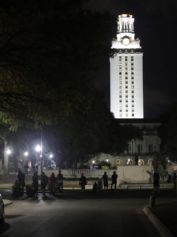
Black students at the University of Texas have filed reports with campus police saying they have been targeted by people dropping bleach-filled balloons at them from above.
While the students believe the attacks are racially motivated and point to continuing racial tension on campus, the campus police and other white students don’t appear to be convinced.
Four students filed reports on Monday, alleging they were targeted in incidents between June and September by objects being thrown from high-rise balconies, according to ABC News.
“We had heard at UT rumors of incidents that had happened, but no one had ever filed a report,” campus police spokeswoman Cindy Posey told ABC. “Our chief of police did his own research, found some things on Facebook, and heard about a couple of people who were hit by balloons.
“Chief Robert Dahlstrom reached out to the kids and said to them, ‘Why have you not filed a report?’ So [on Monday] four people came forward and filed reports.”
Joshua Tang, a senior majoring in history who is African American and Chinese American, said a water balloon hit the sidewalk right in front of him on Aug. 24, staining his jeans, according to the American-Statesman newspaper. Taylor Carr, a black sophomore majoring in anthropology, said she was hit twice in same location as Tang.
“I was, of course, offended and thought, ‘What if this would have gotten in my eyes?’” Tang told the newspaper. “For me, it spoke for a deeper racial and cultural issue we have at UT.”
Tang told the newspaper he did not come forward on his own because he didn’t think anyone would be caught and he feels “police are unfriendly to social justice movements.” Carr said she was not injured in either incident.
But white student Sophie Weiner expressed skepticism to KVUE that the objects were being thrown just at black students because she’s seen things being thrown from buildings for the last three years.
“I see it from my balcony,” Pete Desai added. “I think it is just who ever happens to walk by at the time.”
Student Mackenzie Drake was similarly unsure: “I don’t know. My friend said they had gotten a banana thrown at them and someone said they had a water balloon with bleach thrown at them one time.”
After word spread of the incidents, students and community members held a demonstration and march on campus to protest.
“We are finding that a lot of students do not know what is going on,” student Jamesha Chapple told campus news blog The Horn. “I wasn’t bleach-ballooned, but because it happened to people I care about in this community, I am marching with them.”
Officer Steve McCormick said it would be difficult for prosecutors to prove the incidents were hate crimes, but it would still be considered assault if someone is caught.
“It can be difficult to prove because it is motivation. Motivation can be very subjective,” he said.