The next time you are stuck in gridlock and cursing your wretched commute, imagine this for some perspective: waking up in the dark each morning to travel on dusty, unpaved roads by Tap-Tap — a brightly colored, converted pickup truck in which you sit, squeezed together with nine other passengers in the flatbed, and tap the sides when you want the driver to stop and let you out.
This daily commute was the only thing that kept Anita Joseph’s family afloat after her stock of pig feed, which she sold to locals in her Haitian village, was wiped out by floods earlier this year. Anita traveled 80 miles by Tap-Tap each day to buy goods to sell from her home, earning just enough to feed her family. Today, she no longer makes that trip — Anita is one of 4,000 clients in Mercy Corps’ microinsurance effort called MiCRO (Microinsurance Catastrophe Risk Organization).
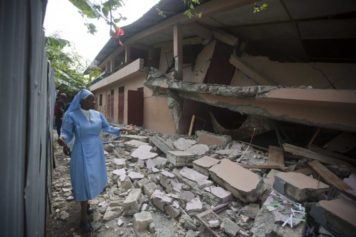
Haiti, with a population roughly equal to my native Los Angeles County, has been often referred to as the “republic of NGOs” because of the nearly 10,000 nonprofit, nongovernmental organizations (NGOs) operating there. Despite this, millions of people still live in destitution and a substantial amount of work is needed to rebuild the basics of a functioning society following the 2010 earthquake. Even so, it is easy to understand why people are drawn to Haiti; it is less than two hours from Miami (one of our nation’s richest cities) and it is entirely possible to create lasting change in this small nation.
In March, I was invited to attend a small Santa Monica event to learn about the work of Mercy Corps. The invitation found its way to me because of my involvement with The Dark Knight Rises and Mercy Corps’ campaign with DC Entertainment called We Can Be Heroes, which enlists the Justice League to help fight famine in the Horn of Africa. Mercy Corps is 34-years-old and has quietly spent more than $2.5 billion helping people in 114 nations. Yet, due to their general aversion towards marketing, I knew nothing about the organization until the event that evening. Fast-forward three months; I touched down at the vibrant Port-au-Prince airport and was on my way to see Mercy Corps in action.
I drove with the Mercy Corps team through downtown Port-au-Prince, instantly awed by the contrast between the Royal Palace, which was still a heap of rubble, and the grand, chaotic Iron Market, an iconic building which was destroyed in the earthquake and rebuilt to meet internationally accepted building codes (prior to the quake, the country had no building codes). The new Iron Market, teeming with transactions, seemed to stand tall as a symbol of hope and progress…
Read more: Josh Pence, Huffington Post