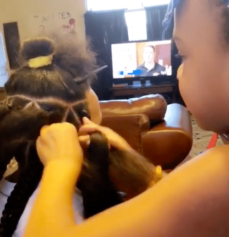
When I set out to make a documentary about black women who are “transitioning” — cutting off their chemically straightened hair and embracing their natural kinky afro texture — I had no intention of appearing in the film. I felt I was an objective observer and really just wanted to highlight a growing movement. (Of the 50 or so women I struck up conversations with randomly on the street, the vast majority had gone natural within the last three years. According to one industry study, sales of chemical straightening kits, which can be harmful, reportedly dropped by 17 percent between 2006 and 2011.) But including my own story forced me to examine how I felt about my hair with more honesty than ever before.
There are as many “natural hair journeys” as there are transitioning women. What I find remarkable about the movement is the way it is spreading through black women in America. Many are transitioning silently, without much fanfare. Some are inspired by friends and family members who have already made the switch. As Anu Prestonia, the owner of Khamit Kinks, a natural hair salon in Brooklyn, told me, “There’s been an evolutionary process that has turned into a revolution.” It is not an angry movement. Women aren’t saying their motivation is to combat Eurocentric ideals of beauty. Rather, this is a movement characterized by self-discovery and health.
But black hair and the black body generally have long been a site of political contest in American history and in the American imagination. Against this backdrop, the transition movement has a political dimension — whether transitioners themselves believe it or not. Demonstrating this level of self-acceptance represents a powerful evolution in black political expression. If racial politics has led to an internalization of self-loathing, then true transformation will come internally, too. It will not be a performative act. Saying it loud: “I’m black and I’m proud” is one thing. Believing it quietly is another. So the transition movement is much more profound and much more powerful — and I believe it offers lessons in self-acceptance for people of all hues and all genders.
To read entire story by Zina Saro-Wiwa and view video, go to NY Times