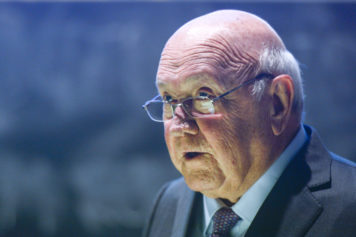
Johannesburg – Former president FW de Klerk must retract comments he made in a CNN interview, the Council for the Advancement of the SA Constitution (Casac) said on Saturday.
“Casac condemns in the strongest terms the reckless attempts by former president FW de Klerk to justify and defend the apartheid system,” it said.
“The very notion of ‘separate development’ was at the center of the apartheid ideology, and was predicated on notions of racist supremacy as was Nazism.”
Casac chairperson Sipho Pityana said De Klerk’s comments made a “mockery” of his claims of being committed to fostering a democratic South Africa.
“Indeed the preamble of the Constitution calls on us to ‘recognize the injustices of our past’ and to ‘heal the divisions of the past’,” he said.
“De Klerk’s comments during the CNN interview constitute a blunt repudiation of these invocations. We urge him to retract these statements in their entirety.”
De Klerk was interviewed by the global news network at a summit of Nobel laureates in Chicago on Thursday night, The Times reported.
He discussed his “historical antagonism” and current friendship with former president Nelson Mandela, the failure of the apartheid system, and the shortcomings of the current government.
When asked whether he agreed that apartheid was morally repugnant, he said: “In as much as it trampled human rights it was and remains morally indefensible.”
However, De Klerk then reportedly said about the homeland system: “But the concept of giving, as the Czechs have it now, and the Slovaks have it, of saying that ethnic unity with one culture with one language [everyone] can be happy and can fulfil their democratic aspirations in an own state, that is not repugnant.”
He denied that blacks in the homelands were disenfranchised.
“They were not disenfranchised, they voted. They were not put in homelands, the homelands were historically there. If only the developed world would put so much money into Africa, which is struggling with poverty, as we poured into those homelands. How many universities were built? How many schools?” he asked.
“At that stage the goal was separate but equal, but separate but equal failed.” He said he later became “a convert” against the system.
When he asked about the state of South Africa’s democracy De Klerk reportedly said: “I’m convinced it’s a solid democracy and it will remain so, but it’s not a healthy democracy.”
Democratic Alliance parliamentary leader Lindiwe Mazibuko said on Friday that De Klerk’s comments were “unfortunate and disappointing”.
It also undermined the work he did in pursuing reconciliation for the country.
“While Mr De Klerk rightfully acknowledges that apartheid was morally indefensible, he too must recognise that the entire concept of racial division through ‘separate but equal’ bantustans was an insult to the dignity of black South Africans,” she said in a statement.
“It resulted not only in the most extreme form of asset stripping, but deprived millions of South Africans of their sense of belonging.”
She said he was an important figure in “our peaceful transition to democracy, and the building of our rainbow nation”.
“We urge him once again to occupy this space, as he did in 1994, to use his words to create hope and unity.”
In the 1950s the apartheid government divided the black population of the country according to ethnic groups or tribes and assigned them to separate regions, which were dubbed ethnic homelands, or bantustans.
The ten bantustans were Bophuthatswana, Ciskei, Gazankulu, KaNgwane, KwaNdebele, KwaZulu, Lebowa, Qwaqwa, Transkei, and Venda.