Post-Civil War Concentration Camps of the U.S.
After the Civil War (and during the war), millions of freed Black people were funneled into concentration camps near Union army bases where conditions were unsanitary and food was limited. Many were killed through forced starvation, and other means. The most notorious of these instances took place in Nachez, Mississippi, also referred to as the Devil’s Punchbowl. The death camp was established after freed Black individuals fled to Natchez after being emancipated.
“When the slaves were released from the plantations during the occupation they overran Natchez,” says researcher Paula Westbrook. “The population went from about 10,000 to 120,000 overnight.”
Here, tens of thousands of freed Blacks were subjected to horrendous conditions that led to their death. In the end, roughly 20,000 Black men, women and children were killed.

Aboriginal Concentration Camps
As a means to “exterminate” the Aboriginal population, the Australian enacted the Aborigines Protection Act of 1909. Under the act, the first Australian concentration camps were established. Dr. Gary Foley, an Australian Aboriginal Gumbaynggir activist, academic, writer and actor, conveyed that the act was established “on the assumption that what was left of the Aboriginal populace would now die.

Black Labor Camps During the Anglo-Boer War
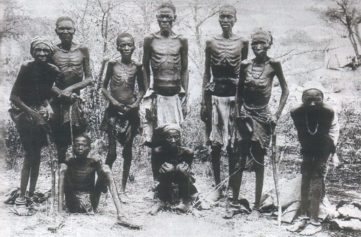
While the two main forces in the Anglo-Boer War were white, Blacks suffered most of the casualties during the war. At least 15,000 Blacks were used as combatants and non-combatants by the British. As a result of the British “scorched earth policy” many Blacks who lived on white farms were moved to concentration camps. In addition, displaced and captured civilians were rounded up by the British forces and forced into “refugee camps,” which soon became known as concentration camps. The British forced the Blacks into camps, namely to make them work, either to grow crops for the troops or to dig trenches, be wagon drivers or work as miners once the gold mines became partly operational again, according to sahistory.org.za.