
Tiphub co-founder Amanda Spann
By Manny Otiko
When most Americans think of Africa, the first thing that comes to mind is disease and starving children, not venture capital and startup companies. However, an increasing number of African Americans are venturing to the motherland to develop business relationships and explore economic opportunities. Nigeria, Africa’s most populous country and biggest economy, has a burgeoning middle class. According to Canadian newspaper The Globe and Mail, there will be 12 million middle-class Nigerians by 2030.
Washington, D.C.-based Tiphub is a consultancy that works with startups and social impact companies in Africa and the Diaspora. The company was created by Amanda Spann, an African American, and Nigerian-Americans Chinedu Enekwe, Chika Umeadi and Adebayo Dawodu.
“We created Tiphub to address key problems that exist for both impact investors and entrepreneurs in the African startup ecosystem including, inadequate risk return profiles, lack of education and skills to cultivate entrepreneurship into bankable projects and exit opportunities,” Spann said.
Tiphub currently works with about 25 companies in Africa and is also partnering with Impact Hub, a company which provides shared workspaces. One of the companies the firm is currently working with is Hello Tractor, a company that helps rural farmers to pool their resources and buy a tractor.
Tiphub also hosts Diaspora Demo Day, a showcase for startups, angel investors and entrepreneurs from Africa and the African Diaspora. Africa is currently going through its own digital revolution with an increasing number of people going online, mainly with mobile devices.
“E-commerce is booming,” Spann said. “It’s really taking off. Mobile banking is huge in Kenya.”
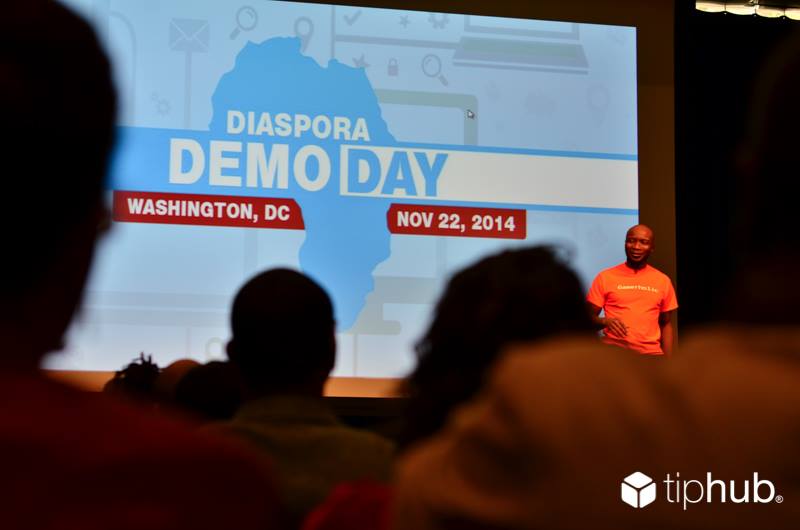
Diaspora Day was organized by tiphub, which aims to build a network for African entrepreneurship.
Spann learned a lot about doing business in Africa when she participated in an innovation tour of several African countries a few years ago.
“What I noticed while traveling is that African and African-American entrepreneurs often face many of the same challenges,” she said. “Ultimately, there is no shortage of genius across the African Diaspora but entrepreneurs here and there both need access to education, capital, and mentorship from stakeholders, who are not only committed to the preservation of these innovators dignity but investing back into their communities.”
She has also learned about the challenges of doing business in Africa. One of the biggest problems working with American partners is the time difference. In addition, many African countries have irregular power supply and high Internet usage fees, which is a problem for online businesses.
Power supply is one of the issues Kwame Dougan has run into investing in Africa. Dougan was born in Ghana, but raised and educated in Canada and the United States. He is managing partner and co-founder of iYa Ventures, a venture capital firm that invests in technology companies in Africa and the Diaspora. IYa Ventures has funded promising businesses in Ghana, Nigeria, Kenya and Ethiopia.
One of the companies iYa Ventures has funded is Supermart, a Lagos, Nigeria-based company that allows busy working mothers to avoid the city’s notorious traffic by ordering groceries online. IYa Ventures is also advising ZNews Africa, a mobile app that aggregates African news.
According to Dougan, frequent power outages are a common occurrence in Africa.
As a result businesses have to run back-up generators for long periods of time.
“That really increases the cost of doing business,” Dougan said.
Another challenge that African startups face is lack of infrastructure. Most business transactions are carried out in cash, and that’s a major issue if you’re developing a business that relies on online payments.
Dougan feels the best African business environment is Lagos because of its energy, innovation and frenetic pace. Ghana is less fast paced than Lagos, but there is plenty of room for businesses to grow, according to Dougan.
“From what I been told, through my network, Rwanda is also a great place as well, if you want to go and develop a business,” Dougan said.
He added another factor that attracts African American entrepreneurs is the cultural environment. Most African countries, like Nigeria and Ghana, are majority Black and race is not an issue.
Manny Otiko has worked in the media for more than 20 years as a journalist and a public relations professional. His experience includes stints as a reporter at a daily newspaper, serving as a media relations specialist for a state agency and working for several Southern California PR agencies. He has secured coverage in publications such as The Los Angeles Times, USA Today, the Associated Press, the Wall Street Journal, CNN.com and Men’s Health.


