The Ku Klux Klan may be largely responsible for the history of white voters in the deep South showing unwavering support for the Republican Party, a new study has revealed.
In recent political battles it seems as if the Republican Party is left trying to fight the perception that their party is the platform for racist voters and that the party has no concern for the Black community.
In the midst of many Black politicians climbing the ranks within the political party, it certainly suggests that those allegations aren’t necessarily true, but the party’s historical background and the political involvement of the KKK could explain why the party is often branded with that label.
During the 1960s the Civil Rights Movement was at its peak and it was enough to threaten many white people at the time.
As a result, the white supremacy group resurged to prominence and moved quickly to divide the races and polarize communities for generations, a study published by the American Sociological Review explains.
The study’s authors say that the group “encouraged white voters to prioritize the defense of white supremacy when making voting decisions.”
What many younger voters don’t realize is that there was once a strong bond in the South between the Democratic Party and white supremacists.
That changed after the national Democratic Party closely aligned itself with civil rights issues and stood in solidarity with African-Americans who were fighting for equality.
The Klan’s push for white voters to focus on voting against policies that would help Blacks encouraged many of the voters to toss their political affiliations aside and gravitate towards politicians who were opposed to desegregation and anything else that would treat Black people as equals.
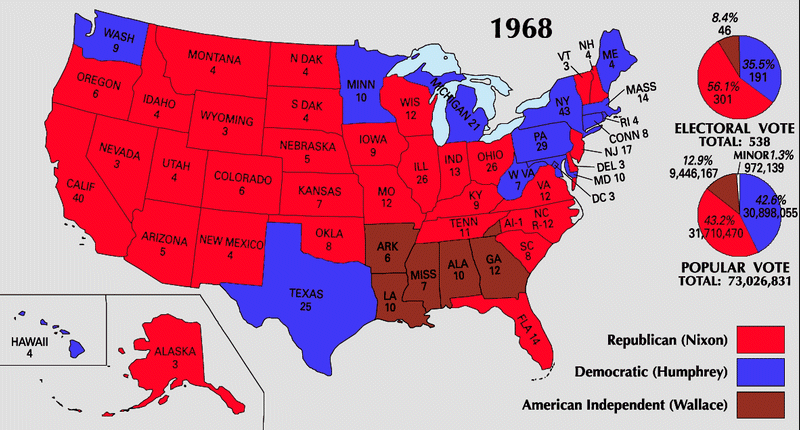
The effect the Klan had on political results was made evident as former Democratic voters started giving their support to Republican candidate Barry Goldwater in 1964 and third-party candidate Alabama Gov. George Wallace in 1968 after he took a firm stance against desegregation.
 After analyzing county voting records in 10 Southern states where the KKK was actively recruiting members in the 1960s, the study’s authors confirmed the white supremacy group’s impact on voting behaviors.
“The Klan played an active role in encouraging white southerners to prioritize white supremacy over party loyalty,” the authors wrote.
Counties with an active Klan chapter were found to be much more likely to back Goldwater and Wallace.
Despite the fact that chapters of the white supremacy group were often formed in counties with high home ownership rates and a high percentage of Black residents, counties that were considered less prosperous and subjected white people to economic competition with Blacks housed the most active KKK participants.
“Given the barriers to voting still in place in the South for blacks in 1964, prior to the passage of the Voting Rights Act, this finding reflects high support among white voters in counties where the perceived threat posed by African-Americans to white interest was greatest,” the authors continued.
By the time the 1970s rolled around, most white voters in the South felt loyal to the Republican Party because they were “more in line with the interest of those opposed to civil rights than was the Democratic Party.”
The study revealed a nearly 4 percent increase in Republican voting in counties that had active KKK chapters compared to counties that didn’t have active chapters of the white supremacy group.
Despite the fact that the Republican Party’s economic views were generally not in favor of working-class southerners, they still remained loyal to the party based purely on the KKK’s call for white voters to make sure any “n****r-loving politician that runs for office” is trumped in the polls by those who supported white supremacy.