closing the educational achievement gap between white students and Black students could boost the United States’ economy by trillions of dollars, according to an analysis by a Washington, DC-based progressive think tank.
Politicians have spent years debating about the best way to boost the nation’s economy but recent statistics suggest that all those educational budget cuts may only add to the problem.
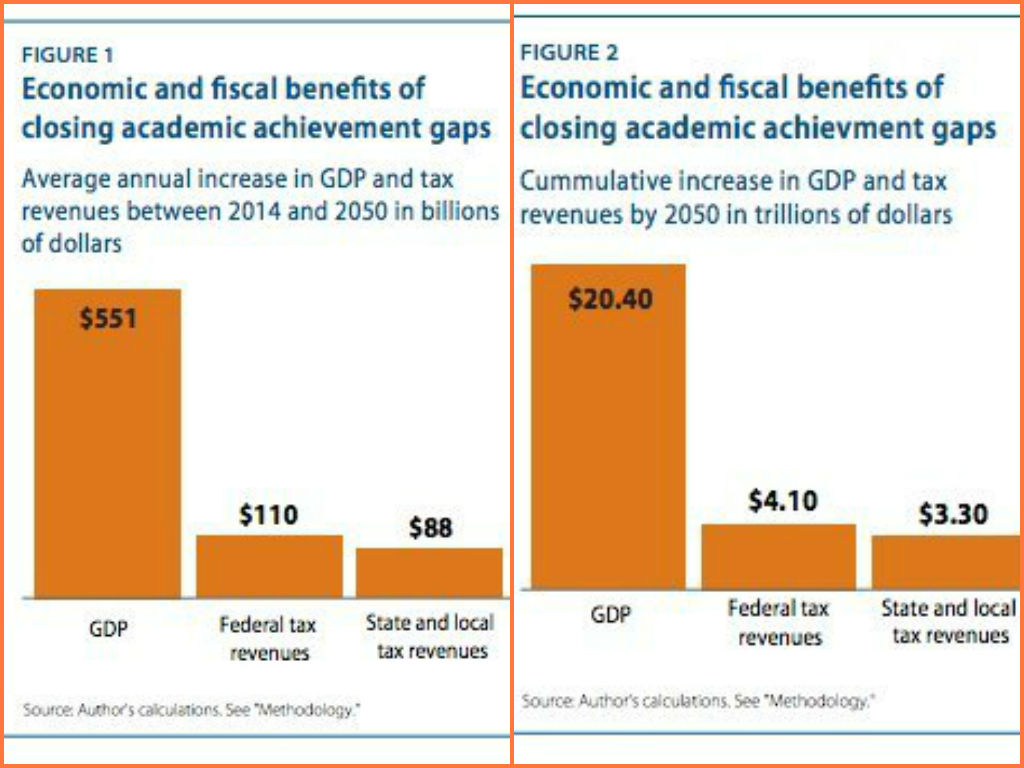
An analysis released by the Center for American Progress suggests that closing the racial educational achievement gap could result in $2.3 trillion of economic growth by 2050.
The analysis took a close look at the scores American students earned on the Program for International Student Assessment (PISA).
The test is taken internationally in 65 different countries.
In the U.S., however, there was a clear distinction between the scores of Black students and their white counterparts.
Black students, many of whom attend school districts that have been targeted by educational budget cuts and insufficient funding, earned average math scores of 421 on the PISA exam. Hispanic students earned an average of 455 on the same exam.
White students, on the other hand, earned an average of 506 on the PISA math exam.
The study didn’t look at the scores of students of other ethnic backgrounds and could have left many multi-racial students unaccounted for, but the information was sufficient enough to make one thing very clear.
“Our simulation indicates the average increase in economic growth that results from the gradual closing of the educational achievement gap and the upgrade in the skill level of the workforce,” Robert Lynch and Patrick Oakford, the authors of the analysis, wrote.
The authors continued by writing, “We found that closing achievement gaps would boost GDP by 5.8 percent, or $2.3 trillion in 2050.”
The massive numbers didn’t stop there.
The authors said this growth represented $765 billion in greater GDP, or more than $1,900 for every man, woman and child in the United States—$7,600 for every family of four.
 The research was based on previous work by economists Eric A. Hanushek and Ludger Woessmann, who determined that an increase of one standard deviation in education achievement yields an average annual growth rate over 40 years that is 1.86 percentage points higher.
In other words, there is a direct correlation between a country’s academic success and economic stability.
With the growing number of students of color, it’s more important now than ever to ensure these students aren’t falling through cracks in the educational system.
“If we think about this year, for the first time people of color are a majority of students in our K-12 classroom,” Oakford said, according to the Huffington Post. “These students are going to be the future of our workforce.”
Oakford also pointed out that policies outside the classroom can still impact students and these are the kinds of issues that need to be brought to the forefront of the nation’s political agenda.
Focusing on early childhood education programs, raising minimum wage, reforming the criminal justice system and investing in social programs are only a few of the solutions that could drastically help close the racial achievement gap in classrooms across the country.
“I don’t think there is a silver bullet to fixing the academic achievement gap,” Oakford told the Huffington Post. “Education reform mostly obviously, but in addition to that, policies that affect a child outside of the classroom….Implementing those policies today means we will be setting ourselves up to reap large economic benefits decades down the road.”