EGYPTIAN WRITING
Perhaps the most famous writing system of the African continent is the ancient Egyptian (Kemetic) hieroglyphs.
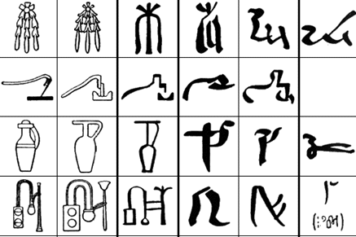
What many people do not know is that the Egyptians invented three scripts: hieroglyphic, hieratic and demotic. These scripts were used by Egyptians for thousands of years.
Hieroglyphic (4000 B.C.–600 A.D.)
The ancient Egyptians called their hieroglyphic script “mdwt ntr” or “medu neter” (God’s words). The word “hieroglyph” comes from the Greek “hieros” (sacred) and “glypho” (inscriptions) and was first used by Clement of Alexandria (c. 200 A.D.) The hieroglyphic script was confined mainly to formal inscriptions on the walls of temples and tombs.
Hieratic (3200 B.C.–600 AD)
Ancient Egyptian hieratic writing was a simplified form of the hieroglyphics, used for day-to-day business and administrative and scientific documents throughout the dynastic history of both Kemet and Kush (3200 B.C.–600 A.D.). Some linguists have also shown similarities between hieratic and the alphabetic proto-Saharan writing.
Demotic (650 B.C.–600 A.D.)
The term demotic was used by Greek writer-historian Herodotus (484–425 B.C.) to distinguish it from the hieratic script.
Whereas hieratic connotes “priestly,” the term demotic is derived from the Greek word demos, which means common people.
The demotic script is the only ancient Egyptian script that was used by just about every Egyptian. It is potentially the world’s first cursive or flowing script, and was mostly confined to pottery and papyri.
It is very important to note that demotic was introduced in Kemet’s 25th Dynasty, which had Nubian or Kushitic origins.