The volume rattles the bones. The gyrations evoke scenes of lustful abandon. In some of funk’s most explicit forms, tracks sprinkled with the prerecorded sounds of machine-gun fire exalt the drug gangs still in control of some of Rio de Janeiro’s favelas. On certain nights, the bass from the amps resonates from the hillside slums into the bastions of the privileged classes, as if to remind them: Rio doesn’t belong just to you.
Funk’s varied repertory provides an apt soundtrack for the changes sweeping across the city after the recent boom that lifted incomes and ushered in the era of megaevents like this month’s World Cup and the 2016 Summer Olympics, while also accentuating longstanding inequality. Samba, forbidden by the authorities about a century ago in much the same way that varieties of funk are prohibited today, has developed into such an establishment fixture that big corporations now underwrite carnival compositions. Bossa nova, the breezy fusion of samba and jazz, seems just too genteel for these times. But funk — often aggressive, sensual, vulgar, narcissistic, anti-establishment and eminently adaptable to Brazil’s shifting political mood — is thriving.
Not to be confused with the kind of American funk popularized by James Brown in the 1960s, Brazilian funk is thought to have crystallized in the 1980s, when favela musicians in Rio drew inspiration from the hip-hop sounds and explicit lyrics of Miami bass. The result was a genre rooted in the lawlessness of the slums. Funk singers were criticized from the start for their hypersexualized, violence-soaked lyrics, but they long defied attempts to tame the genre.
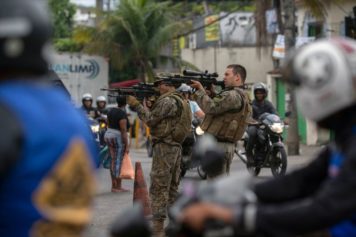
Still, funk surrendered some of its edge when the authorities started asserting greater control over favelas about half a decade ago. In a project called pacification, security forces rolled in with tanks to establish police outposts. They cracked down on the “baile funk,” parties that came to be viewed as subversive. The outcome: Practitioners of proibidão, the prohibited funk style that champions drug gangs, were forced to move to unpacified favelas or change their style to “light,” with the watered-down lyrics the term implies.
Yet in Rio, funk’s cradle, some of the marginalized proibidão singers persist. Some work in favelas is still controlled by gangs, reflecting Rio’s fractious urban peace process. Fewer than 300 of the city’s estimated 1,000 or so favelas are pacified; even in slums now featuring a large police presence, there has been a startling spike in shootings of police officers this year. Around the city, muggings have surged. The homicide rate is also climbing once again in Rio, setting the city on edge just as visitors start arriving for the World Cup.
Amid this tension, new funk stars are emerging, exemplified to a large extent by women like Valesca Popozuda and Anitta. One rising voice in Rio’s clubs is MC Lexa, 19, whose real name is Léa Araújo. She doesn’t come from a favela, pacified or otherwise, but from Jacarepaguá, a sprawling suburban area interspersed with slums. On the cusp of stardom, MC Lexa delayed her civil-engineering studies and has begun performing in cities like Brasília and São Paulo. “Few people have a real chance for a career in funk,” she says. “I need to make this moment count.”
Read full story at nytimes.com