
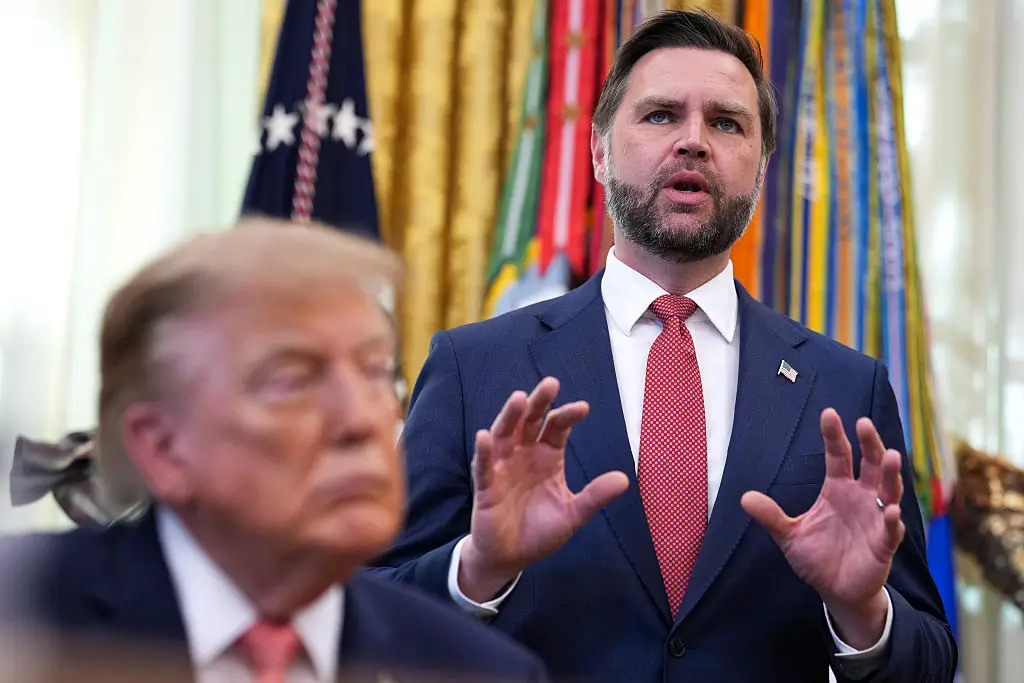
President Donald Trump is reportedly seething behind closed doors over Vice President JD Vance’s public criticism of his ongoing war with Iran.
The day after the Nov. 3 midterm election, when an incoming blue tsunami flipped control of both the House and Senate in Democrats’ favor, Vance took to social media to explain the loss.
He placed the blame for Republicans’ huge defeat squarely on the president and his war on Tehran, arguing that voters had turned against the administration over the conflict and its economic consequences.
The day after the election on Nov. 4, in a post on X, the vice president wrote that frustration over the conflict, along with rising oil prices and the cost of living, had damaged the GOP’s standing with voters.
“The reason we lost is the war. The president himself said so last night,” Vance insisted in the post.
The night before, as massive GOP losses began unfolding in real time on Election Night, Trump told The Wall Street Journal that his war on Iran, then in its ninth month, “was a piece of it.”
He also first told reporters after Vance blamed the war for the defeat, “I think it’s largely true.”
Trump initially appeared conciliatory, seemingly acknowledging that voters had spoken and signaling a willingness to work with the newly Democratic-controlled Congress. He even appeared open to reconsidering some of his most controversial policies, including the Iran war, which has driven up the cost of living, his violent crackdown on immigrants, and his whipsawing tariff program.
That proved short-lived. Less than a week after the election, Trump appointed hard-line sycophant and former Deputy Chief of Staff Stephen Miller to replace Susie Wiles as chief of staff. The move sent a clear message: Trump had no intention of abandoning his deeply unpopular agenda and instead planned to double down.
That must have caused concern among Vance and his supporters. Many see Vance as a contender for the 2028 Republican presidential nomination.
And that concern proved valid. On Wed., Nov. 18, The New York Times reported that behind the scenes Trump has grown increasingly frustrated with how his vice president blamed GOP election losses on the war.
The Times, citing unnamed sources, reported that Trump has been privately complaining about Vance’s post-election analysis and has whined that Vance should have supported his war on Iran as the “right decision.”
The president also said earlier this month that Vance should have “made one other statement,” according to the news outlet.
“If you had it to do again, would you do it again? The answer is yes,” Trump said, describing what he thought Vance should have included in his post-election comments.
Vance has now been scrambling to appease his boss. In an interview Monday on Fox, Vance told Laura Ingraham that when it comes to Trump’s war, there is “zero daylight” between him and his boss.
“No, there’s no daylight, Laura. The president of the United States, he makes decisions. And obviously, within the administration, we have debates and discussions about exactly what to do. When the president makes a decision, he is owed a Cabinet that helps implement that decision,” Vance said.
Following the Times report, as Trump arrived in China for a trilateral summit involving Beijing and Russian President Vladimir Putin, he may have driven another nail into the coffin of Vance’s potential future presidential ambitions by publicly undermining his support for the vice president.
With four little words, Trump dissed Vance’s work on helping broker a ceasefire with Tehran, calling it “a waste of time.”
“We had this, I think, a waste of time. I didn’t like doing it, but I listened to people … but we had a little memorandum of understanding. I never believe too much in memoranda. You go right to a contract.”
A reporter interjected, asking Trump if the MOU with Iran last spring was a mistake.
But Trump backed off. “It wasn’t a mistake. Actually, we got to know them very well during that period and we got to know that they can’t be trusted,” he stated.
The reporter pressed Trump about why he pulled Vance off Iran negotiations after the devastating GOP midterm results and tasked him with investigating Democrats.
“Is that why Vance, the vice president, was pulled off the Iran negotiations?”
Trump denied it.
“No, no. He’s doing a very good job,” Trump insisted.
“He basically just left one thing out. If we had it to do again, would you do it again? And the answer is absolutely yes. What we’re doing is the right thing,” Trump said, doubling down on his war.
Trump launched a war against the Islamic Republic of Iran on Feb. 28 without congressional authorization or a clearly articulated strategy or endgame. The move came despite his repeated 2024 campaign promises to keep the United States out of foreign wars and military conflicts.
First, he said the military operation was about regime change and Tehran’s ballistic missile program. Within a week, he changed course and said it was about preventing the regime from developing a nuclear weapon.
The problem with that explanation? The previous summer, in June of 2025, Trump and Israel waged a 12-day war against Iran, bombing its nuclear sites. Trump then spent the next five months boasting that the attacks had obliterated Iran’s nuclear sites and effectively destroyed its ability to produce a nuclear weapon.


