
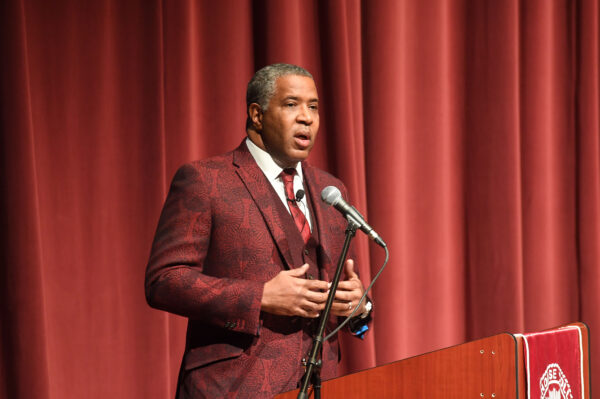
A Black billionaire philanthropist, with a history of relieving debt for students attending Historically Black colleges and Universities, has announced a new program that aims to provide almost $2 million in grant monies to students in the sciences.
According to a press release, Robert F. Smith, founder and chairman of Vista Equity Partners, and his Student Freedom Initiative have partnered with Prudential Financial to launch the Handling Everyday Life Problems for Students Program. Through this collaboration with HBCUs, students can apply for $1.8 million worth of microgrants and paid internships and attend financial literacy workshops.
More than need-based, these grants are for students in high-risk situations or emergencies. The website defines an “emergency” circumstance as “an unexpected, one-time expense, associated with the immediate risk to health, life, property, or student’s environment that requires urgent attention to prevent worsening of the situation or further instability of the student’s situation.”
A study done by the Federal Reserve noted that 40 percent of Americans would struggle to meet an emergency expense totaling $400.
These citizens, many of them African Americans, would have to ask for support from family members or friends or max out a credit card to fulfill the debt. This program seeks to provide a cushion to students that would otherwise be in an irreconcilable bind and possibly have to quit school.
These microgrants can be used for a bevy of things, including supplies for class and other unexpected expenses.
Robert F. Smith, who serves as the chairman of the Student Freedom Initiative, said, “Student Freedom Initiative applauds the leadership of Prudential Financial and their support for our shared mission of eliminating barriers of access for underserved communities.”
He continued, “By enabling the launch of the HELPS Program, a vital component of our work to address the holistic needs of HBCU students and families, Prudential’s gift will provide long-needed and often overlooked aid and support persistence of those most vulnerable in our community.”
Students who consider applying for this program will be asked to participate in research that will expand the HELPS program on Black college campuses. Participation in the study will not be a variable considered when administrators allocate the funds from the program or select recipients.
The goal is to open doors for more students, but knowing the spaces where those needs are can only come from quantitative data ascertained from the demographic HELPS aims to target.
“Over 75 percent of students at HBCUs are considered low-income, relying on Pell Grants to meet their college expenses. However, for many of these students, these grants are not enough,” said Mark A. Brown, executive director of Student Freedom Initiative.
“During recent onsite visits at multiple HBCUs, we learned from executive leadership and student focus groups that many of our students are unable to overcome financial challenges for expenses that are not directly related to the cost of college,” he added.
“These expenses left unaddressed can derail their college plans. In addition, most of these students lack the necessary financial literacy to make informed decisions, though they are asked to sign complex promissory notes that could indebt them well into their adult lives.”
Prudential promises to offer a three-year pilot program with nine HBCUs, to address financial obstacles that present a risk to the student’s ability to get through his or her schooling, and ultimately graduate.
The company will work with the Student Freedom Initiative and the school identified in the program to host “age-appropriate, culturally sensitive, financial literacy education and training for students,” understanding the nuances of their respective economic realities.
In addition to this, the financial institution’s internX.org platform will provide students from these Black institutions paid internships. Highly qualified rising sophomores, juniors and seniors will have an opportunity to secure coveted internships through a network of 220 companies participating in the program.
This is not the first time that Smith has invested in the financial liberation of Black students.
As the keynote speaker at Morehouse College’s 2019 graduation, he offered to pay the student loan debt for the entire class — even if the loans were in the parents’ names. The next year, he donated $50 million to the Student Freedom Initiative to benefit students in the science, technology, engineering or math fields.
In 2021, he reached past the collegiate level of scholars to introduce Black and Latinx youth to the stock market with his “One Stock. One Future” initiative.
His goal was to create 1 million Black and Latino youth shareholders and investors, gifting 15,000 shares of stock to students, staff and faculty members from NY/New Jersey’s Eagle Academy college prep network.
More news from our partners:
Black Americans Might Miss Out on the $68 Trillion Transfer of Generational Wealth. Here’s Why.


