
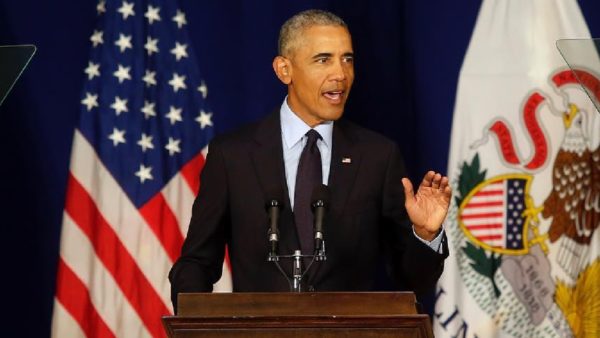
Former President Barack Obama punched a high school friend in the face after the friend called him a racial slur, he claimed during the second episode of the podcast series “Renegades: Born in the USA,” that was released Feb. 22.
“I popped him in the face and broke his nose,” Obama told singer Bruce Springsteen about the incident. The Spotify podcast features a series of conversations between Obama and Springsteen about their lives and love of country in the face of America’s challenges.
In the second episode of the series, entitled “American Skin: Race in the United States,” and during a conversation about the pair’s separate encounters with people using racial epithets, Obama reflected on how he responded when a high school friend directed a racial slur at him.
“When I was in school I had a friend, we played basketball together, and one time we got into a fight and he called me a coon,” the former president shared with Springsteen.
“Now first of all, ain’t no coons in Hawaii,” he joked. “He might not have known what a coon was, but what he knew was, ‘I can hurt you by saying this.’ And I remember I popped him in the face and broke his nose. We were in the locker room, and suddenly blood’s pouring down. It was just reactive.”
The former president said the friend asked him why he punched him, and a young Obama responded, “Don’t you ever call me something like that.”
Obama’s story followed Springsteen’s reflection about how Clarence Clemons, the late saxophonist for Springsteen’s E-Street Band, was mistreated because of his race.
Springsteen said Clemons was regularly “the only Black man in the room.”
Obama and Springsteen also discussed calls for reparations in a nation that has begun to re-examine race relations and the legacy of slavery since the death of George Floyd.
“Here we sit today, where it feels like a reckoning is being called for,” Springsteen said. “Is the country ready to deconstruct its founding myths … is it prepared to consider reparations, do you think?”
Obama responded, saying reparations are justified “theoretically” without question, adding that a significant portion of the country was built “on the backs of slaves.”
“They built the house I stayed in for a while,” Obama said.
However, he challenged the practically of fully executing a plan for distributing reparations for descendants of slaves.
“Could you actually get that kind of justice?” Obama questioned. “Could you get a country to agree and own that history? And my judgment was that as a practical matter that was unattainable.
“What I saw during my presidency was the politics of white resistance, the talk of welfare queens and the talk of the underserving poor and the backlash against affirmative action —all that made the prospect of actually proposing any kind of coherent, meaningful reparation program struck me as, politically, not only a nonstarter but potentially counterproductive.”
The podcast series “Renegades: Born in the USA” will feature six episodes released weekly, exclusively on Spotify.


