

With its new initiative to offer visas on arrival to African visitors, Ethiopia hopes to spur tourism, trade and investment, as part of the African Union’s vision of creating “seamless borders” across the continent and achieving economic integration. (photo: Twitter, Ethiopian Airlines).
Ethiopia has revamped and streamlined its visa system for visitors from African nations in a move that will spur tourism, trade and investment, and has broad implications for African unity.
As of Nov. 1, Ethiopia has implemented what is known as a visa-on-arrival service for African travelers to the East African nation, allowing foreign visitors to receive a visa upon arrival, and effectively opening its doors to all people arriving from throughout the continent.
“It is truly an honor and a special privilege to witness this historical and truly inspirational day. Ethiopian Airlines has been bringing Africa together and closer to the world for over seven decades,” said Ethiopian Group CEO Tewolde Gebremariam at a ceremony held at the African Union Commission headquarters. “Today, Ethiopian flies to 60 African destinations and connects the continent to over 50 major international cities in five continents. Visa on arrival for fellow African brothers and sisters and, more importantly, visa online will greatly boost cross-border tourism, trade and investment, further deepening African integration.”
The new Ethiopian visa announcement comes on the heels of a new e-Visa service that was launched in June. That service, initiated by the Ethiopian Immigration and Nationality Affairs Main Department in collaboration with Ethiopian Airlines, allows all international visitors to apply and pay for a tourist visa online and receive it by email message, reducing wait times and streamlining the travel process, and eliminating the need for travelers to go to the Ethiopian Embassy in their home country to apply for a travel permit. The driving force behind the revamped visa service is “a new national initiative to transform the tourism sector” in Ethiopia, according to a press release, as Ethiopian Airlines hopes the new visa initiative will facilitate conference tourism and boost tourism flow. For the airline, which is unquestionably the largest carrier in Africa, the visa plan falls into its pan-African strategy of further connecting and creating alliances in the African airline industry.
The recent steps taken by Ethiopia — Africa’s second-largest country in terms of population and the continent’s fastest growing economy — has taken point to a larger trend that other African nations are expected to follow. This as Ethiopia ultimately wants to enable the economic integration of the continent and facilitate the AU’s promotion of the free movement of people across Africa. Kenya, Rwanda, and Mauritius have all eased visa restrictions in the past few years, and Ghana has offered visas upon arrival to all African nationals, even as some African nations have gone in the other direction.
For example, South Africa has eased restrictions on Chinese and Indian visitors, but not on travelers from within the African continent. In addition, Tanzania has reversed its visa-on-arrival policy for Nigeria, Mali, and Somalia.
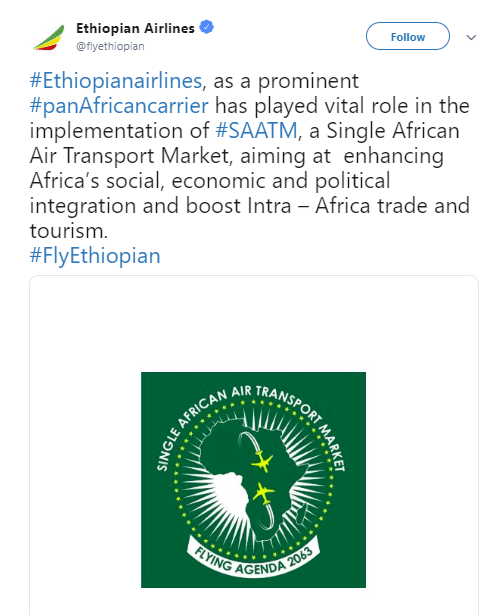 The AU, which is headquartered in Addis Ababa, has urged all member nations to issue a visa-on-arrival program by 2023. The AU Agenda 2063 also calls for the issuance of an African Common Passport by 2023. In 2016, the AU announced the launch of an e-passport, which will be initially available to African heads of state, government ministers and permanent representatives of AU member nations. Such moves ultimately will create “seamless borders” across the continent in a European Union-style concept, and allow for closer steps toward economic integration of Africa. In February 2018, the AU introduced a Single African Air Transport Market (SAATM), an effort to liberalize civil aviation and break down barriers to trade and labor movement in Africa, which have stifled African development over the years. SAATM promises to increase airline connectivity across the continent and enhance competitiveness in the African airline sector, resulting in an expansion in tourism, trade and commerce within Africa and with the rest of the world. The AU expects a unified airline market — which includes the lifting of visa restrictions and dropping tariff and customs restraints — will bring about 300,000 additional direct jobs and two million indirect jobs.
Last year, the AU launched the “.africa” domain, which aspires to unite Africa on the Internet just as the member nations seek greater connectivity in the air and in travel, trade and investment.
With the introduction of an innovative and streamlined visa program for its fellow African travelers, Ethiopia is setting a standard for Africans to follow, in a pan-African vision of economic cooperation that can only boost the continent.


