Today is the 46th anniversary of the founding of the Black Panther Party by Huey P. Newton and Bobby Seale in North Oakland, CA.
It is hard to overestimate the enormous impact that the Panthers had on the self-image of the black community, particularly on the heels of Dr. Martin Luther King’s nonviolent movement. While King’s methods were undoubtedly successful, they could accurately be described as passive. But the Panthers, preaching self-defense and self-love, were anything but passive. Their more militant approach to black equality had a huge psychological impact on the community and was a significant factor in the Black Power and Black is Beautiful movement that erupted in the late 60’s.
Newton and Seale were self-educated black men who came together to create a 10-Point Program for black revolution—”Land, Bread, Housing, Education, Clothing, Justice and Peace.” Calling for equality in housing, employment, education and healthcare, the manifesto also demanded that blacks be freed from military service, remunerated for slavery, freed from prison and be allowed to establish an independent black colony through the oversight of the United Nations.
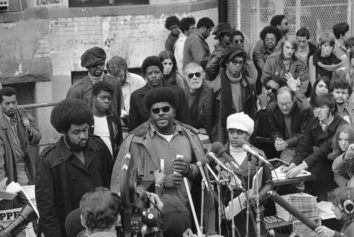
Within three years, the BPP boasted more than 10,000 members across the country—men like Eldridge Cleaver, Stokely Carmichael and Fred Hampton—and captured the imagination of the black community with its shotguns, uniforms and berets. The newspaper, The Black Panther, led by Cleaver, had a circulation of 250,000 at its height.
It was clear that the organization had touched a nerve in America—FBI director J. Edgar Hoover called the Panthers “the greatest threat to the internal security of the country.” And Hoover undertook a program (called COINTELPRO) of surveillance, imprisonments and undercover infiltration with a vengeance, effectively tearing apart the Party in less than a decade. But while they were alive and thriving, the Panthers demonstrated their genuine concern and love for the condition of black people, as evidenced by their Survival Programs in the community, such as the escorts for senior citizens, free ambulance services, medical testing and the free breakfast program that fed more than 10,000 poor black kids every day before school. The Panthers also instituted an armed citizens patrol to monitor the actions of the police department.
By 1980, largely due to the actions of the FBI and other law enforcement agencies, the organization’s membership had dwindled to just 27 people. But the impact of the Party on the mindset of black people lasted far longer.