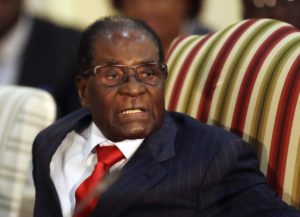
Zimbabwean President Robert Mugabe introduces his cabinet minister during his meeting with South African President Jacob Zuma at the Presidential Guesthouse in Pretoria, South Africa. (AP Photo/Themba Hadebe)
WASHINGTON (AP) — Secretary of State Rex Tillerson called Friday for a return to civilian rule in Zimbabwe, saying the country has a chance to put itself on a “new path” amid signs longtime authoritarian President Robert Mugabe will be forced from power in a bloodless coup.
“We all should work together for a quick return to civilian rule in that country in accordance with their constitution,” Tillerson told a gathering of African foreign ministers and diplomats at the State Department. He said it is imperative that Zimbabwe hold free and fair elections. Mugabe has won previous elections that have been found by observers to have been deeply flawed.
“Zimbabwe has an opportunity to set itself on a new path: one that must include democratic elections and respect for human rights,” Tillerson said. “Ultimately the people of Zimbabwe must choose their government. In our conversations today, we have an opportunity to discuss concrete ways that we can help them through this transition.”
His comments came as the 93-year-old Mugabe made his first public appearance since the military put him under house arrest earlier this week. The military has announced “significant progress” on talks for his departure and arrested some of his allies. Branches of his ruling party, meanwhile, began to pass no-confidence votes in the world’s oldest head of state who has been in office for 37 years. Despite his arrest, Zimbabwe’s military took pains to show respect for the 93-year-old leader by referring to him as the president and the commander in chief.
The Trump administration has taken a largely hands-off approach to Zimbabwe in contrast to the three previous U.S. administrations of Presidents Bill Clinton, George W. Bush and Barack Obama. All three actively sought to isolate Mugabe and his ruling clique for increasing human rights abuses, hoping to encourage a democratic transition. Since Trump moved into the White House in January, however, Washington has been virtually silent on the matter.
Tillerson’s comments on Friday appear to be only the second time he has mentioned the country in a public setting. The first was a three-sentence written statement released by the State Department on the anniversary of Zimbabwe’s independence day in April. All five of his immediate predecessors as secretary of state — Madeleine Albright, Colin Powell, Condoleezza Rice, Hillary Clinton and John Kerry — delivered speeches in which they had denounced Mugabe’s consolidation of power through violent suppression of dissident voices, other rights abuses and the controversial seizures of white-owned land.
U.N. envoy Nikki Haley mentioned Zimbabwe and Mugabe in a June speech but her critique was focused excoriating the U.N. Human Rights Council for failing to address despotic regimes in general.