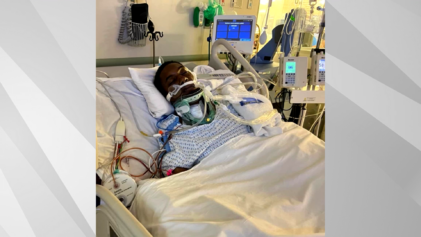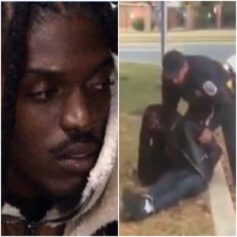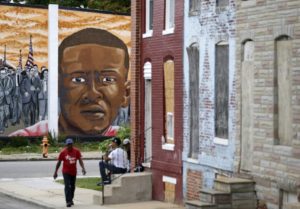
DOJ won’t bring federal charges against six police officers involved in the arrest and death of Freddie Gray, a young black man whose death touched off weeks of protests and unrest in Baltimore. (AP Photo/Patrick Semansky File)
BALTIMORE (AP) — The U.S. Department of Justice said Tuesday it won’t bring federal civil rights charges against six Baltimore police officers involved in the arrest and in-custody death of Freddie Gray, a young black man whose death touched off weeks of protests and unrest in the city.
The officers were charged by state prosecutors after Gray’s neck was broken in the back of a police van in April 2015. The 25-year-old was handcuffed and shackled, but he was unrestrained by a seat belt.
The Justice Department said in a statement that while Gray’s death was “undeniably tragic,” federal prosecutors did not find enough evidence to prove the officers willfully violated his civil rights, a high legal threshold.
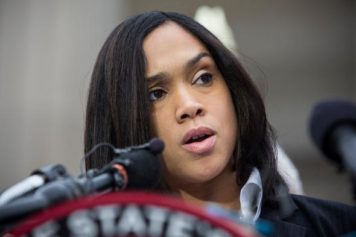
The decision not to bring federal charges against the officers means none of them will be held criminally responsible for Gray’s death. Three officers were acquitted in state court, and Baltimore State’s Attorney Marilyn Mosby later dropped the remaining state cases.
Five officers face internal disciplinary hearings scheduled to begin Oct. 30. Those officers are Lt. Brian Rice, Sgt. Alicia White and officers Caesar Goodson, Edward Nero and Garrett Miller. The sixth officer, William Porter, was not charged administratively.
The Justice Department decision was first reported by The Baltimore Sun. The Baltimore Police Department, Mayor Catherine Pugh, State’s Attorney Marilyn Mosby and the U.S. attorney’s office declined to comment on the decision.
Gray’s death triggered the firing of then-police commissioner Anthony Batts.
It also prompted the Justice Department to open an investigation into allegations of discriminatory policing practices and unlawful arrests. Last year, the Justice Department released a report detailing widespread patterns of abuse and misconduct within the Baltimore Police Department. The federal agency entered into a court-enforceable agreement in January to reform the troubled police department.
On Tuesday, attorneys representing the officers expressed relief that their clients will not be held criminally responsible for Gray’s death.
“These cases were never criminal and should never have been charged as such,” said Rice’s attorney, Michael Belsky.
Joe Murtha, who represents Porter, said he was relieved the Justice Department “determined that there wasn’t a basis to move forward with the civil rights action,” adding: “It’s a good decision.”
Civil rights advocates are watching closely how U.S. Attorney General Jeff Sessions handles investigations of officers involved in racially charged encounters and deaths. While he has promised to hold individual officers accountable for wrongdoing, he also said he intends to pull back on wide-ranging civil rights investigations of police agencies like the one in Baltimore, believing that too much federal scrutiny can hurt officer morale. Sessions had objected to Baltimore’s consent decree, saying it may result in “a less safe city.”
But bringing civil rights charges against police officers is exceptionally difficult in any administration. Authorities in such cases must prove an officer willfully violated someone’s civil rights, a high standard of proof, a challenge that has complicated prosecutions in past police cases.
The Justice Department said its career prosecutors and the FBI devoted “significant time and resources” to investigating the case.
“To the extent that the officers violated department policy in failing to seatbelt Gray, those failures suggest civil negligence rather than the high standard of deliberate indifference,” the department said in its statement. The agency also said it would be impossible for investigators to prove the officers intentionally ignored Gray’s medical needs because he had vomit and blood on his face and appeared not to be breathing at the end of the ride, symptoms he did not show earlier.
Baltimore’s homicide rate began to soar after Gray’s death in 2015, a year when the city saw 344 killings — which broke a 40-year record for homicides. Homicides and overdoses are now threatening to set new records in the city: There have been 245 homicides so far this year, compared to 214 at this time last year.
On Tuesday, local officials and experts gathered at a Maryland Senate committee hearing in Annapolis to address Baltimore’s increasing violence. Sen. Nathaniel McFadden, a Baltimore Democrat, called on his colleagues to work together, saying “the whole state has a problem” when violence hits such high rates in Maryland’s largest city.
“It is everywhere. Help us. Help the engine that runs this state. Address the problem because this is not just Baltimore city. This is the state of Maryland,” McFadden said.
Gov. Larry Hogan, a Republican, announced plans last month for legislation to tighten sentencing for violent criminals to help quell the crime surge.