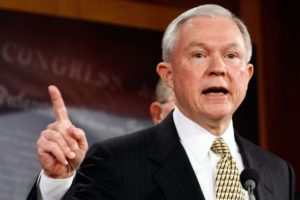
Attorney General Jeff Sessions said the Trump administration will take a federal appeals court’s block of its Muslim travel ban to the Supreme Court. (Photo courtesy of Powerline Blog)
Following another defeat for President Donald Trump’s revised Muslim travel ban in a federal appeals court on May 25, U.S. Attorney General Jeff Sessions said the administration will appeal the court’s ruling in a showdown before the Supreme Court.
In a 10-3 decision, the Richmond, Virginia-based 4th U.S. Circuit Court of Appeals upheld a Maryland federal judge‘s decision in March, which ruled that the revised travel ban that temporarily bars new visas for citizens the six Muslim-majority nations of Iran, Libya, Somalia, Sudan, Syria and Yemen was unconstitutional and appeared driven by religious animosity.
“The president is not required to admit people from countries that sponsor or shelter terrorism until he determines that they can be properly vetted and do not pose a security risk to the United States,” Sessions said in a statement.
The ruling was a win for immigration advocates who argue the president’s executive order amounts to nothing more than discrimination. They cite Trump’s campaign pledge to ban Muslims from entering the country.
“While the administration has tried to justify its ban under an unfounded and unclear cloak of national security, the courts continue to call it out for what it is: religious intolerance, racial animus and discrimination,” said Karen Tumlin, legal director of the Los Angeles-based National Immigration Law Center, in a statement shortly after the ruling.
For the administration, the ruling was a stinging rebuke of the controversial order first issued in January, days after Trump was inaugurated. Its rollout resulted in confusion and protests at airports across the nation. Shortly afterward, the White House made revisions to it, including dropping Iran from the list, after the 9th U.S. Circuit Court of Appeals refused to reinstate the ban.
The fight has been a battle on two fronts for the Trump administration.
Even if the 4th Circuit Court had ruled in favor of the White House, the San Francisco-based 9th Circuit Court has yet to rule on an even broader injunction by a federal judge in Hawaii.
The Supreme Court is unlikely to hear the case for at least another four months as its it present term ends in late June.


