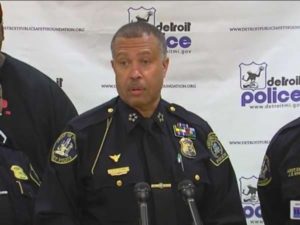
Detroit Police Chief James Craig.
The Detroit police department has arrested four men accused of making threats against officers on social media in a turbulent week that saw two Black men killed by cops and five Dallas officers killed during protests in their honor.
Detroit Police Chief James Craig said one of the suspects wrote on his Facebook page, “All lives can’t matter until black lives matter. Kill all white cops.”
“Social media is new territory, and while it’s been established that hate speech is protected by the First Amendment, we’re talking about people specifically saying on Facebook they want to kill white police officers,” Craig told the Detroit News.
“If someone threatens to kill the president, that person would be arrested and prosecuted. How is it any different when someone threatens to kill white cops?”
Police departments across the country are on high alert following what’s been called the deadliest single attack on law enforcement since September 11.
Police in Norwalk, Connecticut, arrested a 34-year-old resident Saturday who reportedly referred to the man identified as the Dallas shooter as a “hero” on Facebook and called for officers to be killed.
Kurt Vanzuuk was charged with inciting injury to persons or property, according to NBC Connecticut.
A Louisiana sergeant said a teen was locked up for threatening a Bossier City police officer in a social media video.
The Associated Press reports Sgt. Brian Griffiths said Kemonte Gilmore, 19, recorded the video from his vehicle Friday as he sat behind a police car in the drive-thru of a fast food restaurant.
Gilmore allegedly said he wanted to shoot and kill the officer while in possession of a handgun.
He turned himself in that afternoon and was charged with public intimidation.
But one policing expert warned that making a menacing comment is not the same as committing the act.
“There’s a huge difference between somebody sending a threat and somebody actually shooting a police officer,” said Maria Haberfeld, professor of police science at the John Jay College of Criminal Justice, via CBS News.
Haberfeld added that it would be nearly impossible for police officials to regulate Internet chatter due to the massive amount of information on the web.
Bruce Schneier, a world-renowned security technologist at Harvard University’s Berkman Klein Center for Internet & Society, told The Intercept, “Arresting people for speech is something we should be very careful about.”
Last June, the U.S. Supreme Court issued a landmark decision regarding free speech rights on the Internet. In Elonis v. United States, 8 out of 9 justices ruled in favor of a Pennsylvania man who had been convicted and sentenced to prison for threatening his estranged wife through Facebook.
Anthony D. Elonis assumed the rapper alias Tone Dougie to post violent messages for his spouse, who had left him, taking the couple’s children; an FBI agent sent to investigate him; and a class of kindergartners.
“There’s one way to love you but a thousand ways to kill you,” he wrote for his wife.
“Little Agent Lady stood so close/ Took all the strength I had not to turn the b*tch ghost/ Pull my knife, flick my wrist, and slit her throat,” for the agent.
And, “Enough elementary schools in a ten mile radius/ to initiate the most heinous school shooting ever imagined,” for the schoolchildren.
The court determined that prosecutors need not only prove that a reasonable person would interpret the offending remarks as a threat but also that the offender intended for the words to be taken as a serious threat.
The SCOTUS was widely criticized for not making a firm argument for or against freedom of speech in the controversial ruling. In the court’s majority opinion, Chief Justice John G. Roberts wrote, “Given our disposition, it is not necessary to consider any First Amendment issues.”