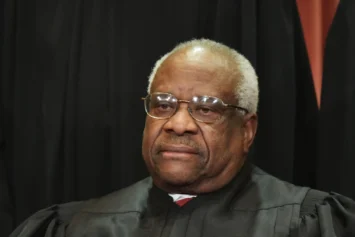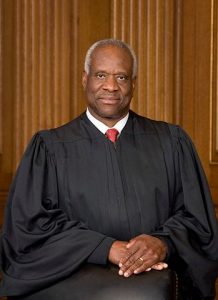
U.S. Supreme Court Justice Clarence Thomas. Wikimedia Commons.
The U.S. Supreme Court may be set to lose another conservative justice regardless of who fills the vacancy at the White House.
Justice Clarence Thomas is considering retirement after the election in November, according to The Washington Examiner. “Washington Secrets” columnist Paul Bedard reports “court watchers” said the judge has long contemplated resigning from his near 25-year post and had no intentions of serving until his death.
His premature departure would have enormous implications for the now evenly divided 4-4 court.
The former U.S. appellate court judge was appointed to the highest court in the land by President George H.W. Bush in October 1991 after three days of salacious confirmation hearings. A press leak revealed that Anita Hill, a University of Oklahoma law professor, told FBI officials Thomas sexually harassed her during his time as chairman of the Equal Employment Opportunity Commission. She was called to testify before the judiciary committee. Thomas infamously referred to the hearings as a “high-tech lynching.” He was eventually confirmed by a 52–48 vote — the narrowest margin in over a century.
The polarizing figure has gained a reputation for being the quietest and most conservative justice on the nine-member panel. He only recently broke 10 years of silence during oral arguments, asking several questions in a relatively small case on domestic violence in February. Legal analysts speculated the startling articulation was inspired by the death of close friend and fellow justice Antonin Scalia.
Thomas has been strongly criticized for his record of voting against significant African-American issues.
Thomas has consistently opposed the use of affirmative action in college admissions, though he acknowledged in his 2007 memoir, “My Grandfather’s Son,” he was a direct beneficiary of the policy.
In March 2015, he voted against a case challenging an Alabama redistricting plan that would have potentially violated the Voting Rights Act of 1965. The Supreme Court voted 5 to 4 to send the proposal to a lower court to reconsider the bill’s impact on African-American voters.
“We have somehow arrived at a place where the parties agree that Alabama’s legislative districts should be fine-tuned to achieve some ‘optimal’ result with respect to black voting power,” Thomas wrote in his dissent, “the only disagreement is about what percentage of blacks should be placed in those optimized districts. This is nothing more than a fight over the ‘best’ racial quota.”
Most recently Thomas was the lone dissenter on a court ruling in favor of Timothy Foster, a Black man convicted and sentenced to death for murder in 1987. Attorneys for Foster argued that prosecutors showed blatant racial bias during the jury selection process, presenting evidence of notes keeping track of African-American jurors in order to secure an all-white jury.