
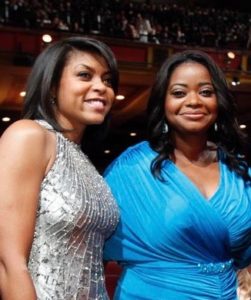
An Academy Award winner and a Golden Globe recipient are about to send a man to space. It’s been confirmed that Oscar-winner Octavia Spencer will join Golden Globe-winning actress Taraji P. Henson in the forthcoming historical space drama Hidden Figures.
The movie centers on three African-American mathematicians who quietly helped send John Glenn to space in the 1962 Friendship 7 mission, making him the third American in space and the first American to orbit the Earth. The film is an adaptation of Margot Lee Shetterly’s book Hidden Figures: The Story of the African-American Women Who Helped Win the Space Race.
Mathematicians Katherine Johnson (who will be played by Henson), Mary Jackson and Dorothy Vaughan are the focus of the film. Spencer’s role in the trio has not yet been announced, but the knowledge that the film is in development is enough to create excitement.
Even in what appears to be an increasing trend toward films celebrating Black history, few narratives have been told from the perspective of Black women, and even fewer from the perspective of intellectual Black women in academic professions. However, the inspiring stories of Black women are there, silently filed away in history.
As Shetterly, a Black author, acknowledges on her official website, after World War II began, federal and defense agencies started opening their doors to women, including those of color. In 1941, President Franklin Roosevelt signed Executive Order 8802, which created the Fair Employment Practices Committee, and prohibited racial discrimination in the U.S. defense industry. This order, which came on the wings of increased pressure from labor and civil rights leaders, led federal agencies and defense contractors to place ads for Blacks to fill employment positions.
The Langley Research Center, in Hampton, Virginia where Shetterly is from, “advertised in Norfolk, VA’s Journal and Guide, seeking machine shop workers, laborers, janitors, and African-American women with math degrees,” Shetterly writes.
Nearly all of these women were top graduates of historically Black colleges such as Hampton Institute, Virginia State and Wilberforce University, but their efforts within Langley were secluded as they were tucked away from their white counterparts in a segregated office in the West Area of the Langley campus. Still, for Shetterly, the face of science and academia didn’t look like the mostly male, mostly white projection that many people know. All she ever knew of science in her younger years was Black.
The author details her experience:
For me, growing up in Hampton, Virginia, the face of science was brown like mine. My dad was a NASA lifer, a career Langley Research Center scientist who became an internationally respected climate expert. Five of my father’s seven siblings were engineers or technologists. My father’s best friend was an aeronautical engineer. Our next door neighbor was a physics professor. There were mathematicians at our church, sonic boom experts in my mother’s sorority and electrical engineers in my parents’ college alumni associations. There were also black English professors, like my mother, as well as black doctors and dentists, black mechanics, janitors and contractors, black shoe repair owners, wedding planners, real estate agents and undertakers, the occasional black lawyer and a handful of black Mary Kay salespeople. As a child, however, I knew so many African-Americans working in science, math and engineering that I thought that’s just what black folks did.
Shetterly’s narrative non-fiction book Hidden Figures, which was optioned for the big screen before it was even complete, is set for a September 2016 release date, and the film adaption that will bring to life the story of brilliant Black scientists through acclaimed Black actresses may help pave the way for other untold stories of Black women to be heard.


