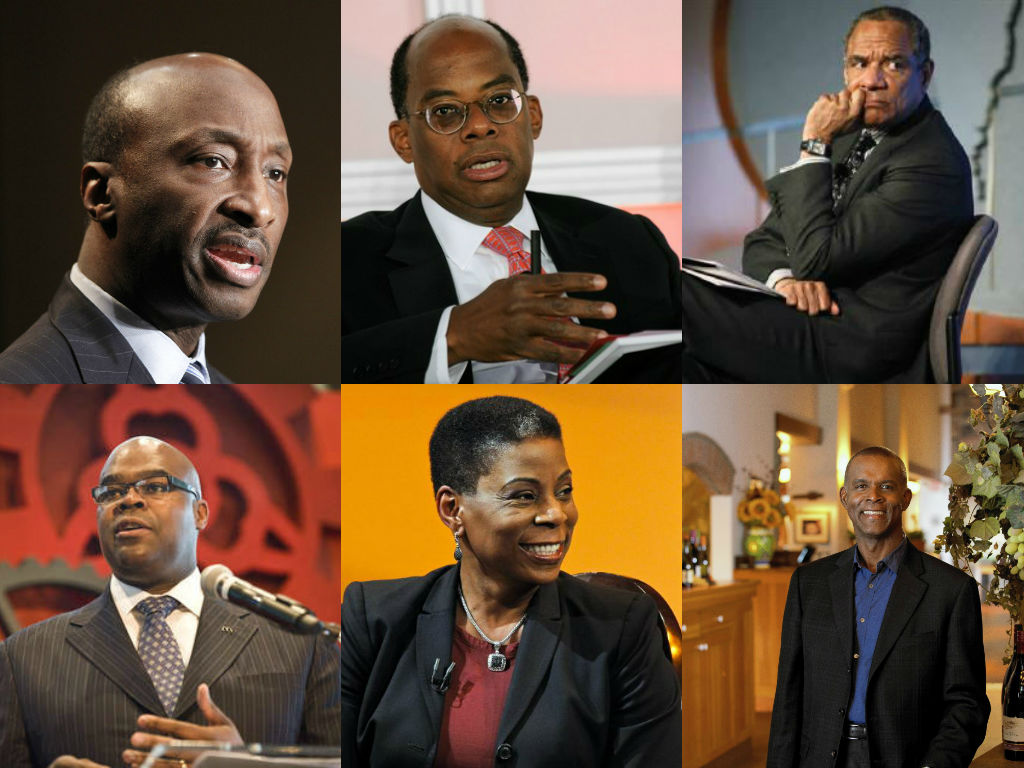
 Most Fortune 500 Companies with Black CEOs seem to be remaining true to their push for diversity and putting people of color in positions of power, but not every company with a Black CEO seems to have diversity reports that support their equality platforms.
Unfortunately, the Fortune 500 list is still far from being diverse itself.
Out of all 500 of the nation’s most successful companies, the number of Black CEOs doesn’t even hit the double digits.
The only Black CEOs on the list are Kenneth C. Fraizer of Merck & Co., Roger W. Ferguson Jr. of TIAA-CREF (Teachers Insurance and Annuity Association – College Retirement Equities Fund), Kenneth I. Chenault of American Express, Donald Thompson of McDonald’s, Clarence Otis Jr. of Darden Restaurants Inc. (who stepped down earlier this year), and Ursula M. Burns of Xerox Corporation (the only Black female CEO on the list).
The good news is that all six of the Black CEOs have diversity at the center of the company’s platform and almost all of them have statistics to back up those claims of equality, especially when it comes to getting females and Blacks in positions of power.
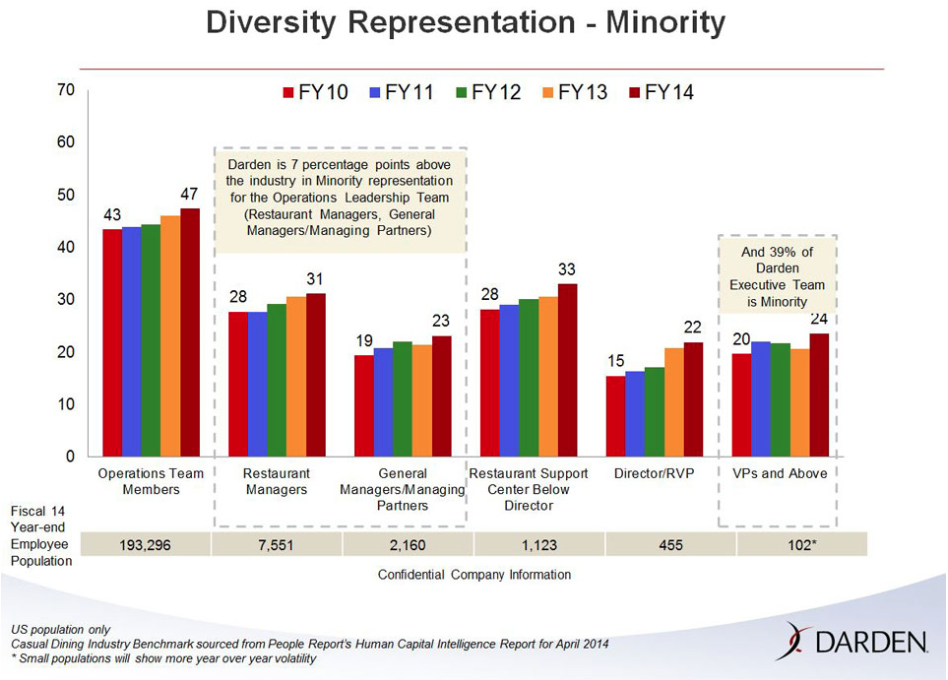
Darden Restaurants has had a consistently positive trend for people of color among restaurant managers, directors and even vice presidents. Over the past four years the company’s number of non-white directors has increased from 15 percent to 22 percent.
The amount of non-white VPs has climbed from 20 percent to 24 percent.
This is a stark contrast to other companies on the list, like Apple, whose diversity reports revealed only about 2 percent of their employees were Black—with hardly any of them being in a leadership position.
McDonald’s had another impressive round of diversity statistics—70 percent of the company’s employees are women or non-white and more than 40 percent of their franchise owners are women or non-whites.
More than a quarter of their women and non-white workers are in leadership positions.
 Meanwhile, TIAA-CREF has emerged as a leader in diversity.
For six years straight the company was deemed one of the best companies for diversity by Black Enterprise and was ranked among the top 10 companies for executive women by the National Association of Female Executives in 2012.
TIAA-CREF was actually the only Fortune 500 Company who had more than three African-American men on its board, according to the 2012 Alliance for Board Diversity Census.
Merck & Co. did decide to publish its diversity data and the findings were rather troubling for a company with a Black CEO.
Out of more than 6,500 officials and managers at the company, only 167 are Black men – accounting for 3 percent of that population.
Only 3 percent are Black females.
Meanwhile, more than 50 percent of that same population consisted of white males and 30 percent consisted of white females.
Neither Merck & Co. nor American Express made the Alliance for Board and Diversity’s top 40 list of diverse boards.
So while Xerox, Darden Restaurants, McDonald’s and TIAA-CREF have been champions of diversity, it doesn’t seem as if Merck & Co. has made the same type of progress.
For its part, American Express has been adamant about one thing in particular concerning its diversity data—keeping the data secret.