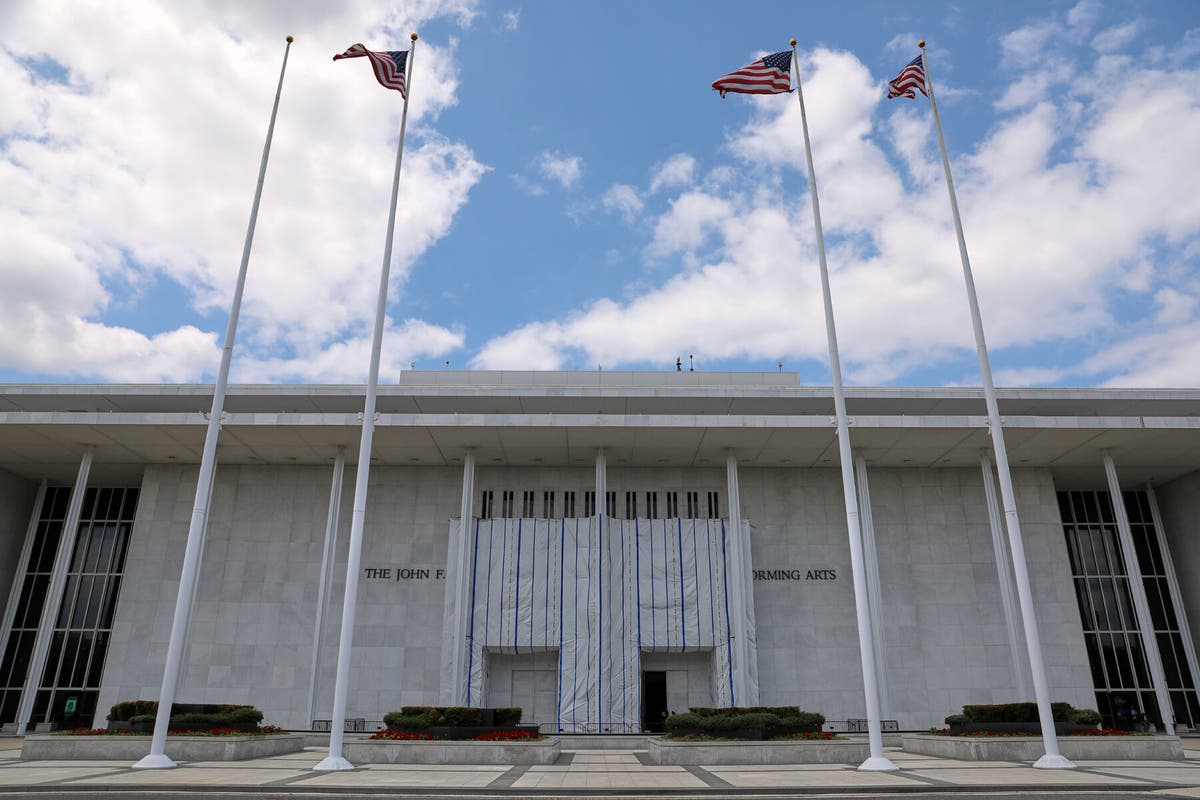
Donald Trump promised to restore the John F. Kennedy Center for the Performing Arts. Instead, his $257 million renovation plan has sparked a growing legal fight, unanswered questions, and a controversy that refuses to fade.
With the center still shrouded in tarps, questions about what lies behind the closure are becoming harder to ignore.
Now, a new court filing has raised fresh concerns about missing messages and records his team withheld until the final days of discovery.
Legal analyst Michael Popok has singled out an unexpected figure in Trump’s inner circle: his longtime aide Natalie Harp, whose communications with Kennedy Center executive director Matt Floca have become part of the legal battle.
According to a privilege log filed in court, the two exchanged 19 messages, including 11 on Sept. 15 alone — the same day trustees voted again to close the building for a two-year renovation.
But Harp wasn’t the only Trump insider whose name surfaced. The filing also identified roughly 180 texts between Floca and Commerce Secretary Howard Lutnick, whose wife, Allison Lutnick, sits on the Kennedy Center board.
The communications have raised questions about how closely Trump’s advisers were involved in decisions about the institution’s future.
Speaking on Tuesday’s episode of “The Intersection,” Popok questioned why Harp, rather than White House chief of staff Susie Wiles, appeared so involved in the discussions.
“Why is she the one?” Popok asked. “Why isn’t it Susie Wiles, the chief of staff? Why is it Natalie Harp who’s the one that is trying to bring down the curtain on the Kennedy Center?”
Popok suggested Harp may have been acting as a conduit for the president, though the contents of the withheld messages have not been publicly disclosed.
The administration is invoking presidential communications privilege to keep those exchanges private, leaving a federal judge to decide whether the records must be turned over.
The dispute adds another layer to Trump’s ongoing battle over the Kennedy Center, which has already suffered a significant legal setback.
In May, U.S. District Judge Christopher Cooper ordered Trump’s name removed from the building’s signage after ruling that the board had improperly renamed the institution. The name was removed in June, but the tarps remained.
The center has been largely empty since the September closure decision, while speculation about possible demolition has fueled questions about Trump’s plans for the historic landmark.
Rep. Joyce Beatty began challenging the president’s plan to rename the center in December 2025. The Ohio Democrat amended her filing to address the closure in March.
The ongoing legal battle to expose the president’s correspondence with board members and those in his inner circle is the latest point of contention in the judicial melee.
An Oct. 25 filing states that Trump’s lawyers waited until the last minute of discovery, on Oct. 23, to hand over a communication log about the Kennedy Center management.
Based on what was provided, Beatty learned that Trump was in “near-constant contact” with the board, including on voting day.
Trump appointed new members and himself as chairman in February 2025.
The filing raises concerns about missing correspondence between Trump and Matt Floca, the center’s director; Natalie Harp, the president’s executive assistant; and Commerce Secretary Howard Lutnick, whose wife, Allison Lutnick, is a Trump-appointed board member.
“He is such a whiny baby. If he can’t put his name on it, then it should come down. What exactly is he trying to hide with burying all these texts? Oh donny boy, someday the truth of all your shady deals are going to come out and then you will have to pay the piper.
“What is the administration trying to hide?” a third reaction read.
Howard Lutnick was among Trump’s cronies who shared video of a chunk of the center’s ceiling falling into the lobby during a storm in early September.
The footage was used to support Trump’s closure agenda.
“Without access to these materials, Plaintiff will lack a complete picture of Defendants’ actions. It should not have taken Defendants this long to produce a privilege log, and their delay unfortunately suggests gamesmanship,” the filing reads.
Defendants also withheld 17 emails covering “planning for the Kennedy Center Honors program.” The 49th annual ceremony will take place at Washington’s Capital One Arena on December 7.
Comedian Billy Crystal, a 2023 recipient of the award, weighed in on the center’s renaming and closure battle.
“I just want — no. It’s just so selfish and so petty,” said Crystal during the Oct. 24 taping of “Connect with Jacob Soboroff.”
Last month, Trump’s lawyers argued that “executive privilege” protected his involvement in discussion about the landmark.
“Take the damn tarp down. It has no purpose there other than to hide what Trump can’t have,” said one detractor.
Beatty’s rebuttal explained that Trump acts as chairman, not the president. Therefore, his communication with parties tied to the Kennedy Center should not be protected.
The Kennedy Center was built to honor a president whose legacy belonged to the American people. Now, its future hangs in uncertainty as the building remains covered and the legal battle over its management continues.
Until officials answer the questions surrounding the missing records and the center’s closure, the public is left wondering what remains hidden behind the tarps — and whether this landmark will ever feel like a public memorial again.
NEW: Plaintiffs suing to halt Trump closure & renaming of Kennedy Center submit court filing arguing Team Trump is shielding 100s of records showing "Trump’s ongoing, direct management of the Kennedy Center", including Kennedy Ctr staff messages to Natalie Harp & Howard Lutnick https://t.co/8ATaE8FxFo
— Scott MacFarlane (@MacFarlaneNews) October 25, 2026


