President Donald Trump can’t seem to catch a break. Just hours before delivering his State of the Union address, he was once again staring down a problem he’s spent months trying to smooth over and repackage as progress.
But no matter how often he insisted everything was under control, he couldn’t outrun the steady slide in approval — and voters kept signaling that whatever he was selling, they weren’t buying it.
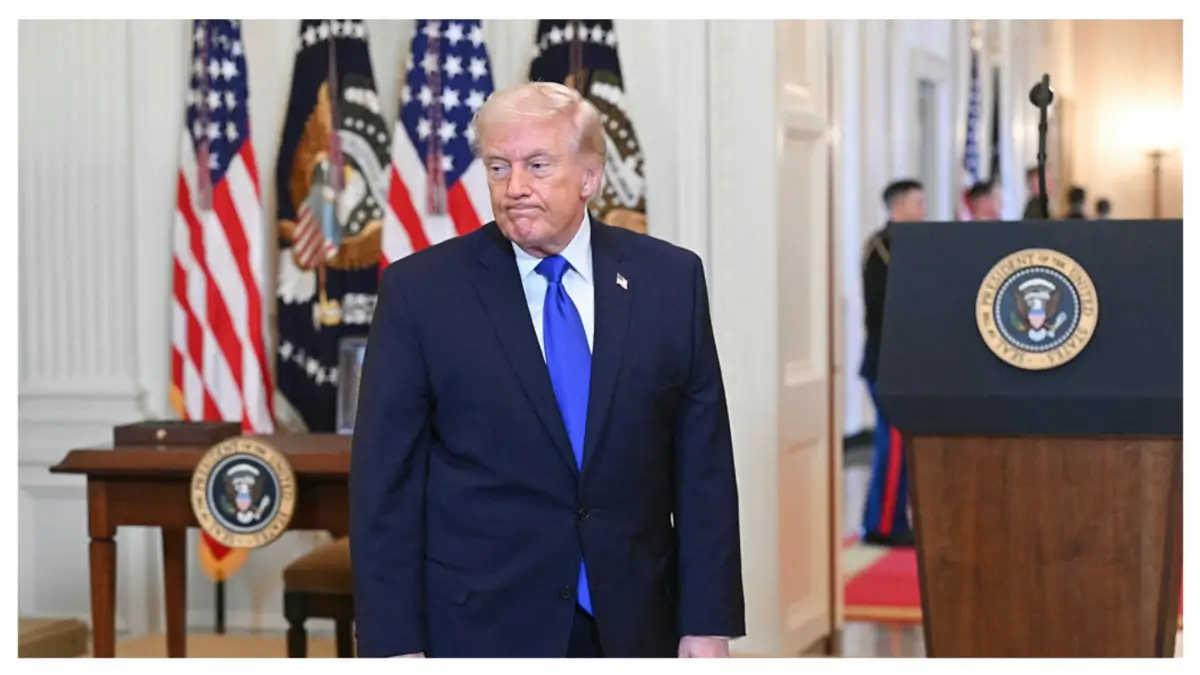
In the weeks leading up to the speech, a string of awkward moments and sagging poll numbers chipped away at the confidence he projects onstage. Then came the exchange that cut through the noise. When pressed in an NBC interview about why Americans remain deeply pessimistic, Trump was caught off guard — unable to find cover fast enough and left with what looked like an unfiltered moment of honesty.
“I don’t know. I don’t know,” Trump said after being confronted with polling showing voters are dissatisfied with inflation and the rising cost of living.
But days later, after the Supreme Court struck down a centerpiece of his economic agenda, that uncertainty gave way to fury, and one of his fiercest political rivals says he saw it coming.
In a 6–3 ruling Friday, the Supreme Court invalidated Trump’s 2025 tariffs imposed under emergency powers, declaring that only Congress can levy tariffs and dismantling the legal foundation of his “Liberation Day” agenda.
Rather than concede ground, Trump escalated.
Within hours of announcing a 10% global tariff under Section 122, he signaled he would raise it to 15% for countries he accused of “ripping” the United States off for decades.
The aggressive response revived comments from California Gov. Gavin Newsom, one of Trump’s top political adversaries, who had predicted exactly this scenario.
Last week, Newsom warned that Trump would likely lose at the Supreme Court on the tariff question.
“He’s gonna lose likely on the Supreme Court on the tariff question,” Newsom said. “Trump isn’t strong. He’s weak, masquerading as strong.”
He went further, predicting the economic fallout would hurt Trump politically: “Trump’s gonna get shellacked in the midterms. He knows that.”
After the Court ruled Friday, Newsom responded bluntly: “Donald Trump was finally held accountable for using his illegal tariffs to take hundreds of billions of dollars from Americans. And he’s already throwing a tantrum.”
On social media, one user reposted Newsom’s earlier prediction with a short caption: “This aged incredibly well.”
Other reactions were more sarcastic and blunt.
“Republicans, clean up on aisle 47. Big mess,” one X user wrote, suggesting the president’s economic strategy had backfired.
Another declared, “He’s going down. Took long enough.”
The remarks reflect a growing narrative among critics that Trump’s tariff agenda, once touted as a signature strength, has become a legal and political liability.
The contrast between Trump’s recent admission of confusion and his combative posture after the ruling has not gone unnoticed.
During his NBC interview, Trump insisted he was “starting to get great polls on the economy.”
“The polls on the economy, they’re not great,” NBC Nightly News host Tom Llamas corrected him.
“They should be great,” Trump replied.
“They should be — so why aren’t they?” Llamas pressed.
“I don’t know,” Trump conceded raising his hands up in defeat.
When Llamas pointed out that Americans say “it’s expensive out there,” Trump suggested the issue was messaging, not policy.
“I just don’t think we’re selling it properly. We’ve done a great job,” he said.
Critics now argue Friday’s Supreme Court decision undercuts that claim.
Economists have also publicly questioned the effectiveness of Trump’s tariff strategy. In a widely circulated clip shared by University of Michigan economist Justin Wolfers, he was seen having a hearty laugh when asked about the effectiveness of the tariffs — a moment critics say underscores skepticism even within financial circles.
Meanwhile, key economic indicators continue to complicate Trump’s narrative.
Inflation, which peaked at 9 percent during the pandemic, had fallen to roughly 2.8 percent by the time Trump returned to office in January 2025. It currently sits near 2.7 percent — still above the Federal Reserve’s 2 percent target.
Trump has highlighted a 4.3 percent GDP figure from last year, though that reflected third-quarter growth rather than full-year expansion. Independent projections for 2025 place growth closer to 2 percent.
Job openings have dropped to their lowest level in five years, according to recent Bureau of Labor Statistics data.
Polling reflects the unease. Trump’s overall approval rating remains in the low 40s, with a majority disapproving of his handling of the economy.
For critics, the quick pivot from “I don’t know” to a vow to impose a new global tariff after a Supreme Court rebuke reinforces Newsom’s earlier assessment that the president’s economic bravado masks clear vulnerability.


