Students at three North Carolina universities, including the nation’s largest HBCU, filed a federal civil rights lawsuit on Jan. 27 against state and county election officials who rejected their efforts to keep early voting sites on their campuses.
The lawsuit filed in North Carolina’s U.S. District Court (and obtained by Atlanta Black Star) accuses North Carolina’s Republican-led State Board of Elections of “targeted efforts to place additional, unnecessary, burdensome, and ultimately unjustifiable obstacles” on students and asks the court to reinstate the campus voting sites before early voting begins Feb. 12, ahead of the March 3 primary election.
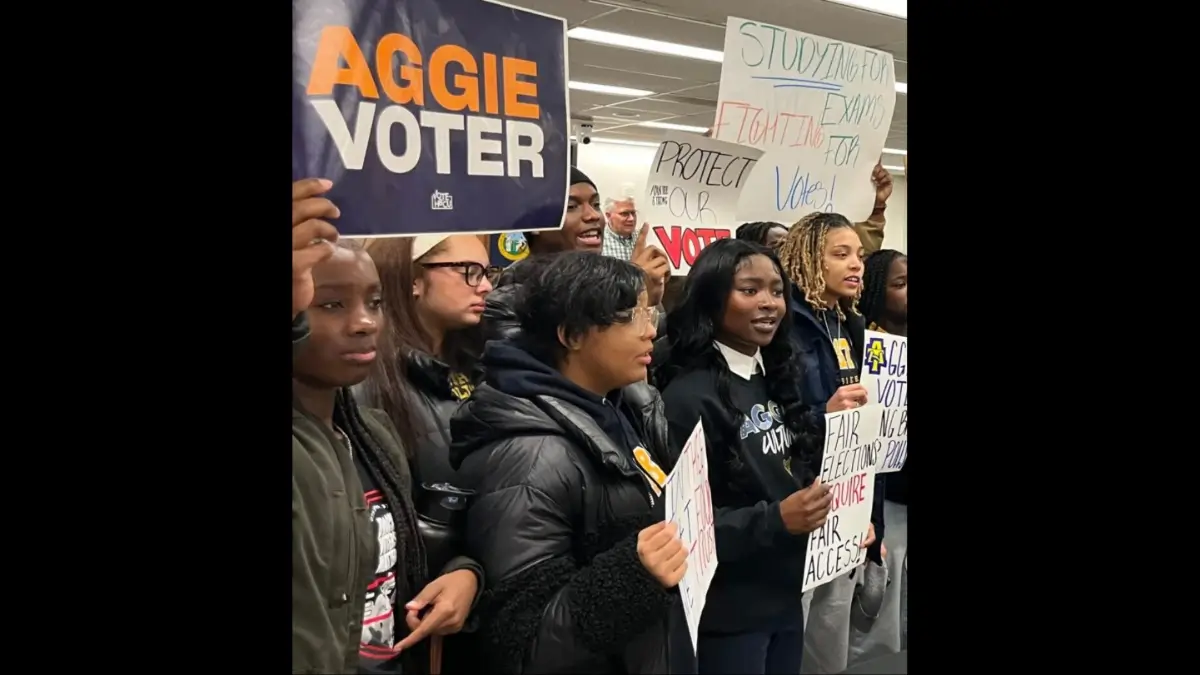
The plaintiffs, including College Democrats of North Carolina and students from Western Carolina University (WCU), University of North Carolina–Greensboro (UNC-G), and North Carolina A&T State University (NC A&T), allege that the board’s removal of campus voting sites violates the constitutional rights of young and minority voters in multiple ways.
The students argue that eliminating campus voting locations will significantly burden young voters, as college students disproportionately rely on early-voting sites that are accessible, integrated into campus life, and offer same-day registration.
Many students don’t own cars or have access to reliable transportation to travel long distances off campus to vote, the complaint contends.
The nearest early voting location to WCU is now a recreation center nearly two miles away from campus, located in rural Jackson County in the Appalachian Mountains. The area has virtually no public transportation, reliable taxis, or ride-sharing services, the lawsuit says. Students without personal vehicles (64 percent of all students) will be forced to walk that distance along a four-lane highway with no sidewalks or walkable shoulders, raising safety concerns.
For students who can’t walk that far, including those with disabilities, “the cost and hassle of taking a taxi or shuttle to reach the nearest early voting site may be enough to dissuade them from voting at all,” the lawsuit says.
Eliminating the WCU voting site is “particularly harmful,” the complaint asserts, given that its campus early voting site has historically served more Black voters than any other Jackson County voting site, has the highest proportion of same-day registrants in the state, and the second youngest average pool of voters in the state.
Same-day registration, available only during early voting, has proven critical to enfranchising student voters, as many have recently turned 18 and are registering to vote for the first time. Collectively, the three universities serve more than 40,000 students, the majority of whom are Black or from other minority groups.
The plaintiffs argue that the state election board’s decision to eliminate the campus early voting sites violates the Twenty-Sixth Amendment, which prohibits age discrimination in voting, as well as the First and Fourteenth Amendments, which bar election practices placing a burden on the right to vote unless justified by “legitimate state interests.”
The defendants — the North Carolina State Board of Elections, the Jackson County Board of Elections, the Guilford County Board of Elections, and many of their officers — have failed to provide any legitimate justification for removing the campus voting sites, the lawsuit claims.
The reasons proffered by elections board officials for eliminating the early voting sites included cost savings, logistical issues such as access to parking, and suggestions that voter turnout is too low, the lawsuit says. Those justifications “are as troubling as they are thin.”
Board officials claimed that eliminating the WCU site would save the county $20,000. But a Jackson County elections board member argued that savings from removing the WCU site would be only about $6,000, due to increased staffing costs for the one remaining early-voting site in the precinct. Moreover, WCU provides the physical space, IT support and dedicated parking for the site, minimizing the county’s costs.
The Guilford County Board of Elections supported its decision to close the early voting sites at NC A&T and UNC-G by citing low turnout.
The lawsuit argues that NC A&T is “a hotbed of campus-level political activity” and, as the nation’s largest HBCU, “is a trailblazer for mobilizing young Black voters.” In the 2020 election, the first year its campus voting site opened, 70 percent of NC A&T students cast a ballot, up from less than 60 percent in 2016.
Meanwhile, UNC-G students also turned out to vote in record numbers after its on-campus site opened in 2020: 74 percent of eligible students voted in the 2020 presidential election, up from 57 percent in 2016, well exceeding the 66 percent turnout among the U.S. voter population at large in the 2020 presidential election.
On Jan. 13, about 50 NC A&T students packed the State Board of Elections meeting in Raleigh to support early voting. Students said they were laughed at, threatened with police intervention, and ultimately ignored, as the board voted against their campus polling place.
Afterwards, Zayveon Davis, a student at NC A&T student (and plaintiff in the lawsuit) told the Citizen Times he was disappointed, but “I hope that everybody leaves here knowing that your voice does matter. Your vote does matter. And if it didn’t, they wouldn’t be working this hard to take it away.”
Since Republicans took control of the North Carolina election board in May, it has taken several steps to restrict voting in the state, reported the News Observer. The board has worked closely with the U.S. Department of Justice on a legal settlement requiring voters to provide more personal information or risk being disenfranchised.


