In another case of government overreach, a South Florida woman was ordered to pay $165,000 in fines for improperly parking in the driveway of her own home, after the state Supreme Court refused to hear her case last month.
The main offense against Sandy Martinez was that two tires of a car parked in her driveway were touching the grass on her property, which led to a $250-a-day code violation in the town of Lantana in Palm Beach County that accumulated over time.
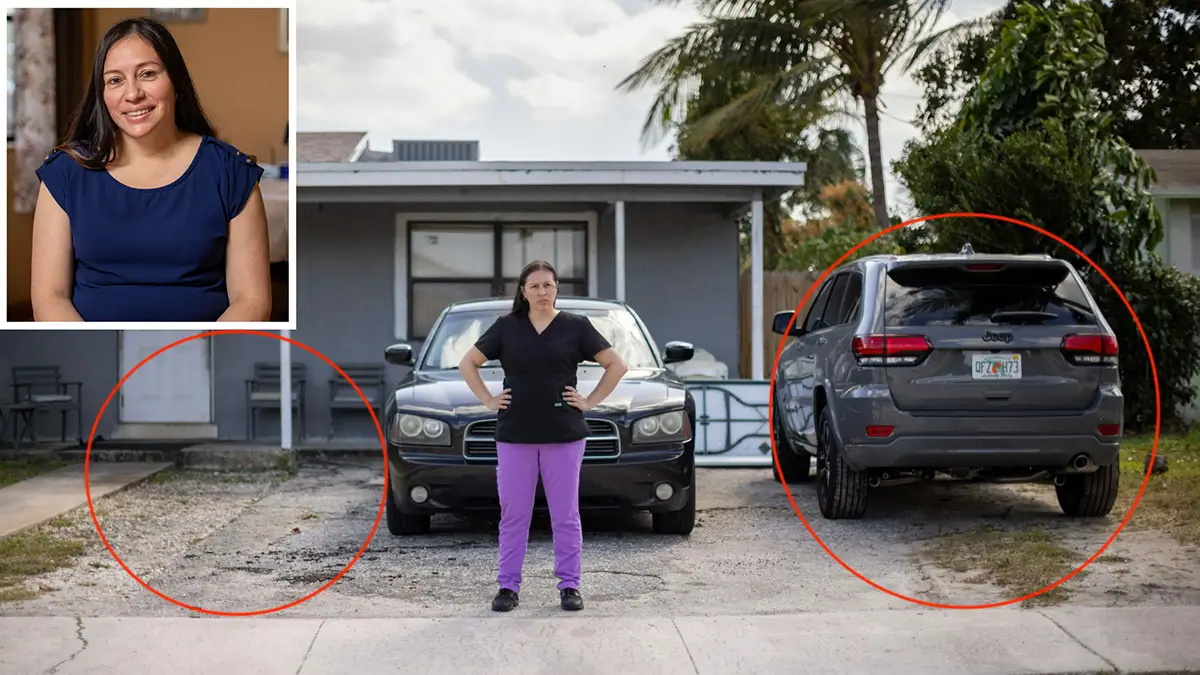
But the town had also fined her $75-a-day for cracks in her driveway as well as $125-a-day for a downed fence that was damaged during a storm, the latter of which accrued into $47,000 while she was waiting for her insurance to provide her the money to rebuild the damaged fence.
Martinez said her driveway was not wide enough to properly fit the four cars in her household without the tires of the outside cars touching the grass and gravel on either side of the driveway on her property. And it was not long enough to park behind each other because then the cars would obstruct the sidewalk which would lead to another violation. The single mother lives in the home with her sister and adult children who all work and need the cars to commute. She has since widened the driveway.
She also said code enforcers from Lantana would not visit her home after she came into compliance, allowing the fines to accumulate even though she had resolved the issue.
“When you call the town of Lantana to get a hold of the inspector to let them know that you’ve done what you’re supposed to do,” she told local media during a 2021 press conference announcing her lawsuit.
“You leave voicemail after voicemail, they call you, you call them, you’re playing phone tag, and finally you’re like, you know what, I’m not calling anymore,” Martinez explained.
“I’ve let them know I’ve complied, come check it out. No, they let the fines run for over a year, and that’s ridiculous,” she added.
Martinez was represented by the Institute for Justice, whose main argument in the lawsuit was that the fines were a violation of the Florida Constitution’s Excessive Fines Clause, which was designed “to prevent people from being fined into poverty for trivial violations.”
But the Florida Supreme Court did not see the fines as excessive, leaving Martinez in a financial hole where she is robbed of the home equity she has built up over the years, the IJ said in a press release last month, adding the state cannot foreclose on her property due to the Florida homestead exemption.
“Six-figure fines for parking on your own property are shocking,” said Ari Bargil, senior attorney for the Institute for Justice, in response to the state supreme court refusing to hear the case.
“The court’s refusal to hear Sandy’s case and clarify the constitution’s protections from run-away government fines is a disservice to all Floridians.”
‘Repeat Offender’
Martinez’s battle with Lantana began in 2013 when the town fined her for having cracks in her driveway, leading to a $75-a-day fine for 215 days, resulting in a total fine of $16,125, which was far more than the cost of a new driveway, court records state.
She fixed the driveway in 2014, coming into compliance with the violation, but then in 2015, code enforcers fined her $125 a day for the fence damaged in the storm, which accumulated to $47,375 after 379 days while waiting for her insurance to pay for the fence.
Then in 2019, code enforcers fined her again for improperly parking in her driveway, resulting in a $250-a-day fine because she was now considered a “repeat offender.”
Court records said she came into compliance with the driveway issue a little more than a year later in 2020, but by then she had accumulated $98,500 in fines totaling more than $165,000 with the previous fines as well as interest added by Lantana – which was nearly four times her annual salary and more than half the value of her home.
The Institute for Justice filed its lawsuit in 2021, accusing Lantana of implementing excessive fines in violation of Florida’s constitution.
“The government cannot lock you into a lifetime of crushing debt for such harmless code infractions,” stated the Institute for Justice in a press release at the time.
“The punishment must fit the crime.”
But in 2024, a circuit court judge ruled on behalf of Lantana, pointing out the town offered her to pay a reduced settlement, but since she was unable to afford it, she must now pay the full amount.
“Unable to pay the fines, on August 20, 2020, the City offered Plaintiff a settlement of $25,000 to be paid by December 18, 2020, or else the original fines would be reinstated,” Florida Circuit Court Judge Luis Delgado Jr. wrote in his opinion in 2024, granting summary judgment to Lantana.
“Plaintiff was unable to pay the settlement and thus, the original fines were reinstated.”
The Institute for Justice appealed the decision, but the Fourth District Court of Appeals for Florida sided with the lower court, ruling that the fines were not excessive, citing a previous unrelated case of a couple in Fort Lauderdale accumulating $700,000 in fines for a home valued at $200,000 after 14 years of daily fines for code violations, which set precedent for Martinez’s case.
“The trial court did not err in finding the fines were not grossly disproportionate to the violations,” the appellate court ruled.
‘Code Enforcement is a Cash Cow’
The Institute for Justice then petitioned the case to the Florida Supreme Court in June 2025, arguing the state’s highest court has not addressed the excessive fine issue for more than a century, allowing municipalities to abuse their power at the expense of the homeowner.
“Municipal code enforcement is a cash cow in Florida. Some locales, like Lantana, even generate millions annually from code enforcement fines,” states the petition by the Institute for Justice, a national nonprofit law firm that specializes in government abuses like civil forfeiture and botched raids – and encourages citizens to reach out to them for free legal help, especially in cases like excessive code enforcement fines.
The petition also highlights the lack of communication with Lantana that allowed the fines to accumulate even after she corrected the violations.
“She filled in the driveway cracks once she saved the money. She rebuilt the fence with insurance proceeds. And she promptly rearranged the cars (and eventually widened the driveway),” the petition states.
“As for the parking violation, after rearranging the cars, Sandy called Lantana for a reinspection. That inspection never came. So the fines kept accruing, all without her knowledge.”
The petition also urged the Supreme Court to put a stop to municipalities abusing code enforcement fines to enrich themselves at the expense of the elderly and poor.
“Financially catastrophic fines like Sandy’s have grown commonplace in Florida,” the petition states.
“Without this Court’s intervention, this problem will continue to worsen.”
But on Dec. 22, the Florida Supreme Court denied the petition, allowing the previous court decision to stand, enabling municipalities to bankrupt citizens with daily fines that can surpass the value of their home.
“It’s outrageous that the Florida Supreme Court won’t consider whether the constitution protects Floridians from ruinous fines,” said Martinez. “Cities shouldn’t be allowed to wreck lives over trivial violations.”


