7 Findings From the State of Black America Report That Prove the Black Community Still Has a Long Way to Go

black-young-man-job-seeker

Income Inequality Still a Serious Problem

There was no severe decline when it came to the income inequality index, but there was also a lack of progress. “The Black-White Income Equality Index rankings were relatively stable between 2014 and 2015,” the report explained of its extensive list of major cities ranked by income inequality. In some communities, Black household income tumbled by more than 5 percent. Even in the best cities for income equality “the median Black household [had] 71 cents for every dollar of median white household income.” Other cities had even lower numbers where the gap equated to Black residents only having 42 cents on the dollar when compared to their white counterparts.
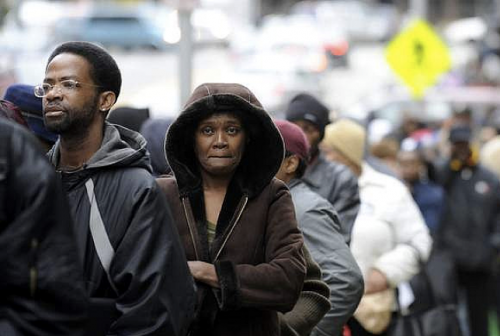
Federal_Assistance_Line_Detroit

Black Citizens Disproportionately Unemployed in Metro Areas

Many metro areas have significant numbers of Black residents, but many of these residents are left struggling to find work. The State of Black America report looked at several major metro cities across the nation and found that employment inequality was a problem that plagued many of these cities. “With an index of 65 percent, the smallest Black-White unemployment gap was in the Providence-Warwick, RI-MA metro area where the Black unemployment rate was 13 percent and the white rate was 8.5 percent,” the study reads. These troubling numbers are a part of why economic progress has been slow based on these reports.

Democracy needs journalism it can trust.

This election season, the stakes are higher than usual — and so is the pressure on newsrooms to soften their coverage, stay quiet, or just disappear. Independent reporting, the kind that answers to readers instead of advertisers or political pressure, matters more in a moment like this, not less.

For over 14 years, Atlanta Black Star has stayed independent and reader-funded. We have no corporate owner and no shareholders telling us what to cover or how to cover it. That independence is also our biggest vulnerability: nothing protects it except readers choosing to fund it directly.

Newspaper ad revenue has fallen more than 80% since 2005, and local newsrooms are closing at a rate of roughly two a week nationwide. When outlets go under in a moment like this, it's rarely the independent, reader-funded ones that get to stick around.

We know a request for support isn't why you came here. But without readers choosing to fund this work directly, the depth of reporting we can do at home and abroad shrinks along with everyone else's. If you're not in a position to give, that doesn't change how much we value you as a reader.

If you are able to, a recurring contribution does more for us than a single one-time gift, because it lets us plan the next investigation instead of just the next invoice. It takes about 30 seconds, no long form, no account. Thank you for continuing to support independent journalism and freedom of the press.

Back to top