
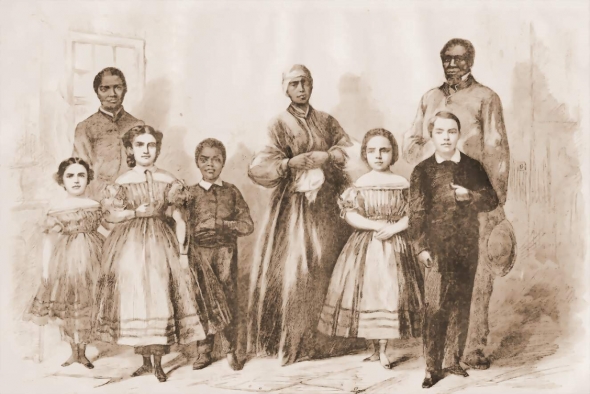
- While blasting the king of England for, “violating its most sacred rights of life and liberty,” Jefferson was busy working boys as young as 10 years old in his nail factory. After it opened in 1794, for the first three years, Jefferson recorded the productivity of each child and rewarded those who produced; others were assigned as field laborers.
- In an effort to minimize race-mixing, Jefferson tried to restrict free Blacks from entering or leaving Virginia while a member of the Virginia House of Burgesses during the 1770s. In addition, he would have expelled any white woman who had a child with a man of African descent. Reportedly, any free Black found in violation of the laws would be in jeopardy of the lynch mob. The law was never passed due to its extreme nature.
- Despite his strong stance on interracial coupling, Jefferson is believed to have fathered six children with his late wife’s mixed-race sister-in-law and chambermaid to his children, Sally Hemings. Several studies strongly indicated Jefferson fathered the children. In 1998, the Thomas Jefferson Foundation reviewed the evidence of previous DNA tests and found that Jefferson was the father of Eston Hemings, and that he was likely the father of all six of Sally Hemings’ children.
—-Sources——-
http://www.monticello.org/site/plantation-and-slavery/thomas-jefferson-and-slavery
http://www.pbs.org/saf/1301/features/archeology.htm
http://www.si.edu/Exhibitions/Details/Slavery-at-Jefferson%27s-Monticello-Paradox-of-Liberty-4757
http://www.monticello.org/site/plantation-and-slavery/thomas-jefferson-and-sally-hemings-brief-account
http://www.lectorprep.org/jefferson_and_slavery.html


