
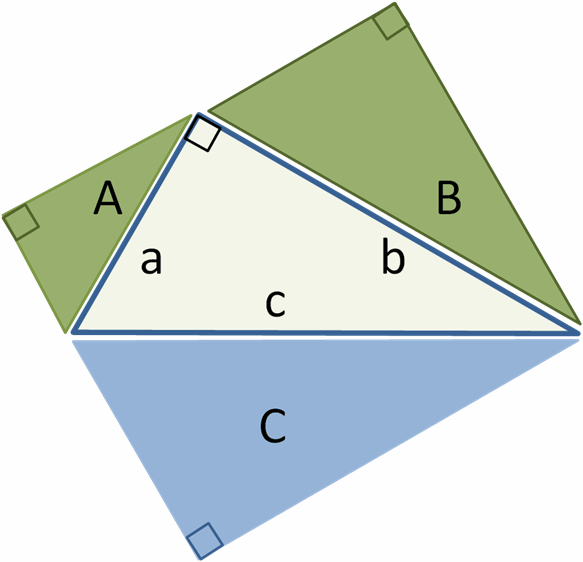
 Pythagorean Theorem
Since the fourth century A.D., Pythagoras has commonly been given credit for creating the theorem in geometry that states that in a right-angled triangle the area of the square on the hypotenuse (the side opposite the right angle) is equal to the sum of the areas of the squares of the other two sides—that is, a^2 + b^2 = c^2. This is commonly called the Pythagorean theorem.
But the theorem was known and previously used by the Babylonians, Indians and Egyptians. The way in which the Babylonians handled Pythagorean numbers implies that they knew that the principle was generally applicable, and knew some kind of proof, which has not yet been found in the (still largely unpublished) cuneiform sources.
Because of the secretive nature of Pythagoras’ school and the custom of its students to attribute everything to their teacher, there is no evidence that Pythagoras himself worked on or proved this theorem. For that matter, there is no evidence that he worked on any mathematical or meta-mathematical problems, says Walter Burkert, a German scholar of Greek mythology and cult.


