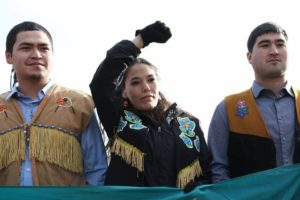
Leaders from the Gwich’in Nation and Inupiaq Tribe traveled from northern Alaska and the Yukon Territory in Canada to lead a pray in against the bill in Congress allowing oil and gas drilling in the Arctic. (Photo Credit: Liz Gorman)
Apparently, not all monuments are created equal, at least from the standpoint of President Trump and leaders in Congress. As Trump champions the preservation of Confederate monuments that pay homage to white supremacy and slavery, he takes actions that would destroy the ancestral lands of Native peoples. These monuments of Native Americans, the burial grounds, the artifacts, fossils and places of ancestral, cultural and spiritual significance, are susceptible to looting, drilling and mining.
As if to erase not only the legacy of his predecessor but the legacy of native people, Trump announced his decision to significantly reduce two Utah national monuments: Bears Ears National Monument — created by President Obama last year as part of 5.7 million acres he reserved in federal land — will shrink by 85 percent. Grand Staircase-Escalante, which Clinton created in 1996, will be reduced by about half. The former has oil, gas and uranium deposits, while the latter contains mineral deposits. This move by the president, reflecting an executive order directing the Department of the Interior to review more than a hundred national monuments, means that 2 million acres of land will no longer have federal protection. This represents the largest loss of federal land in U.S. history, according to conservation advocacy groups.
“You know how best to conserve this land for many, many years to come,” Trump told a crowd as he was surrounded by Republican lawmakers in Salt Lake City on Monday. “They don’t know your land and truly they don’t care for your land like you do. From now on that won’t matter.”
Five Native American tribes played a role in the establishment of Bears Ears National Monument — Hopi Tribe, Navajo Nation, Pueblo of Zuni, Ute Indian Tribe, and Ute Mountain Ute Tribe — land which is still used for cultural and religious purposes. The Native American Rights Fund, representing these sovereign nations, filed a lawsuit against Trump’s action in Utah. The complaint claims Trump has made an “unlawful attempt to revoke and replace a
national monument of major historic and scientific importance in violation of the United States Constitution and the Antiquities Act of 1906,” which was enacted by President Theodore Roosevelt in 1906 as the first legal protection of cultural and natural resources in the United States. The Native American tribes say that no president has tried to abolish a national monument by proclamation, and the Antiquities Act does not authorize the nation’s chief executive to do so. Trump, the nations allege, has exceeded his authority under the Constitution.
“Bears Ears has been home to Native peoples since time immemorial and is still cherished by Native peoples for its cultural, spiritual, and archaeological importance. Bears Ears
contains hundreds of thousands of objects of historic and scientific importance, many traditional cultural properties, and many sacred sites,” the plaintiffs said in their complaint. The tribes still use Bears Ears for a variety of religious, cultural and medicinal purposes, including the collection of plants, minerals, water and other items, hunting, fishing, providing offerings at archaeological sites and conducting ceremonies. Some ceremonies require items that are only available on this land. while some tribal members hold grazing permits and allotments on the land.
NARF notes the Trump administration’s other actions against indigenous people, including granting a permit to the Dakota Access Pipeline and Keystone XL, and revoking the executive order to protect the Bering Sea on April 28. Along with his harmful policies towards these sovereign nations, Trump has a history of making insensitive remarks towards native peoples. He has referred to Sen. Elizabeth Warren as “Pocahontas” — mocking her claims of Native American ancestry — which he reiterated in crass fashion recently during a White House ceremony honoring World War II Navajo code talkers.
In 1993, Trump gave testimony before a House subcommittee, claiming the mafia was involved in the Native American gaming casinos, and that certain tribes “don’t look Indian.”
This news comes as the Republican tax cut proposal making its way through the Senate would allow for oil drilling in the 1.5 million-acre Arctic National Wildlife Refuge in Alaska. America’s indigenous nations have decided to take action on these threats to their heritage and culture.
Leaders representing the Gwich’in Nation and Inupiaq Tribe, both of which extends across the borders of what is now the United States (Alaska) and Canada came to Washington, DC on December 6 to lead a pray-in in against the tax bill and drilling in the Arctic, on the 57th anniversary of the Arctic Refuge. Holding signs reading “Protect the Arctic,” “Indigenous Rights are Human Rights,” and “Don’t Use the Tax Bill to Attack Indigenous Rights,” they were joined by Senators Elizabeth Warren (D-MA), Jeff Merkley (D-OR) and Mark Udall (D-CO), and Representative Alan Lowenthal (D-CA).
“We must resist the fossil fuel industry’s continued attacks on Indigenous rights and sovereignty,” said Dallas Goldtooth of the Indigenous Environmental Network, and MC of the rally, in a statement provided to Atlanta Black Star. “The Tax Bill being debated is bad across the board, but it especially highlights the ugly collusion between fossil fuel interests and the GOP. We must draw the line on the protection of our Indigenous homelands, we must defend the sacred.”
“We are outside the Capitol today to assert our Tribal Sovereignty and Indigenous identities, and affirm our commitment to protecting sacred places and demand Congress do the same,” said Bernadette Demientieff, Executive Director of the Gwich’in Steering Committee.
“I’m a hunter living a subsistence life in the Yukon, a life that was passed on to me by my parents and generations of family,” said Jeffrey Peter, Vuntut Gwich’in from the Yukon Territory. The Gwich’in are dependent on Porcupine Caribou, whose calving grounds extend from the Yukon territory in Canada to northeastern Alaska and include the Arctic National Wildlife Refuge. Drilling will put North America’s largest Caribou herd at risk, indigenous and environmental groups say. “I’m going to be a father soon, and I deserve the right to pass this life on to my son. Congress has no right to take that away from us — we cannot allow drilling in the Arctic Refuge.”
America’s original people, victims of land theft, dislocation and genocide, have struggled to live amid broken treaties and broken promises. Once again, their homes and culture are being threatened, and they are fighting to ensure justice is served.