The phrase “There’s an app for that!” touches many facets of modern life, to include transportation, finance, communications and entertainment. Apps, or computer applications, typically flow from the fertile minds of young, white male coders. Microsoft founder Bill Gates’ software-writing prowess laid the foundation for a $508-billion corporation and helped revolutionize personal computing for billions of worldwide consumers.
Intent on leading more Black and Latino high school boys to the coding dance floor, New York City activist Christina Lewis Halpern created All Star Code. “We all want and need a seat at the table, and then we want to run the table and then we want to have our own table. Coding is the ticket to that,” says Halpern, whose father, Reginald F. Lewis, was a Wall Street attorney who acquired and deftly operated a billion-dollar international food business, TLC Beatrice International, before succumbing to brain cancer in 1993. Fortune magazine had listed Lewis as one of the country’s 400 wealthiest individuals.
Still, Halpern is keenly aware that “the playing field isn’t level. America was built on a legal structure where African-Americans were excluded from money, power and fame. But we’ve made progress!”
She started All Star Code two decades after her father’s death. “My family foundation is committed to social justice and believes in the power of entrepreneurship and investing in our community.” Halpern says. “We seeded this initiative and provided an anchor grant. About 20 percent of the money invested in All Star Code last year was from the Reginald F. Lewis Foundation, or Lewis family personal funds.”
Last year, an annual All Star Code fundraising event in the Hamptons generated more than $740,000 for the nonprofit organization. Beginning in 2014, All Star Code’s centerpiece has been a free, six-week Summer Intensive computer science program designed to give Black and Latino high school boys the access and exposure they need to become successful tech entrepreneurs.
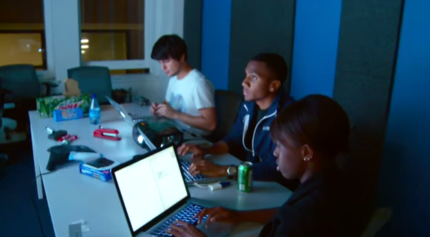
During the six-week initiative, the high schoolers are guided through a computer science curriculum that includes guest speakers, mentoring networks and exposure to work culture. And of course scads of software coding. Graduates of the Summer Intensive finish with basic web development skills, an entrepreneurial mindset and a network of peers who also love building things that matter, Halpern states. Twenty boys participated in the 2014 Summer Initiative, a number that rose to 160 this summer. All Star Code is aiming to have at least 1,000 high school participants in 2020. Ninety-five percent of All Star Code’s students went on to attend four-year colleges, with 85 percent majoring in computer science or a related field.
The first three Summer Intensives only took place in New York City, but this year’s Summer Intensive was held in New York and Pittsburgh. More cities will be added, Halpern says. Displaying her dad’s powers of persuasion, she got a bevy of leading technology, media and financial services companies to back All Star Code in 2017.
Bond Collective, Cisco, Comcast, Facebook, Goldman Sachs, JP Morgan Chase, MLB Advanced Media and Yahoo! joined forces to provide All Star Code with operational support and $350,000 in funding. “It’s an honor for Cisco to support All Star Code and their mission of fostering diversity and entrepreneurial success across young men, who we believe will be best positioned to address the complexities of an ever-changing business and technology landscape,” says Cisco Senior Vice President and Chief Strategy Officer Hilton Romanski.
Employment pegged to computers and information technology is expected to increase 12 percent from 2014 to 2024, surpassing the growth rates of every other field, according to the U.S. Department of Labor, which projects the creation of 488,500 new jobs. Additionally, the median annual wage for computer and information technology jobs was $82,860 in May 2016, compared with a median annual wage of $37,040 for all occupations.
While the tech industry is one of the fastest-growing industries and the highest-paying, All Star Codes notes that only 1 percent of venture capital-backed startups have a Black or Latino member on their founding team.
Halpern says that with demand for software innovation currently through the roof, thanks in part to the explosive growth of cloud computing, future Black and brown tech billionaires will be inevitable. “Of course we will see an African-American or Latino founder create a company that transforms how we live and also makes billions and billions of dollars,” she says matter-of-factly.
With some arguing that girls of color may face even higher barriers to coding and computer science than boys of color, why is Halpern focusing on guys? “All Star Code invests in Black and Latino high school male students because while STEM organizations for girls continue to grow, there are currently no national organizations fostering, exposing or educating young men of color for careers in the tech industry,” she says. Halpern adds that All Star Code’s male-centric charter isn’t cast in stone, and that she will reach out to allies within female STEM groups if her organization ever goes coed.
In the meantime, All Star Code will continue to immerse Black and Latino high school boys in Computer Science/Entrepreneurship/Wealth-Building 101. “The problem we are ultimately solving is the wealth gap in the United States,” Halpern says. “The solution is to create the opportunity for people to earn money in ways that are commensurate with their talents and abilities.”