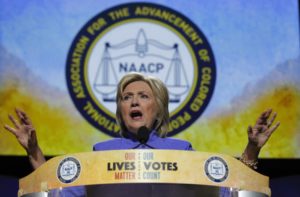
Former Democratic Presidential candidate Hillary Clinton addresses the crowd at the 107th Annual NAACP Convention in Cincinnati, Ohio. (Photo by John Sommers II/Getty Images)
Democrats must strongly consider putting an African-American candidate on the ticket if they plan to win back the White House, a number of Black activists say.
The issue stands to be a topic of concern as hundreds of Black leaders gather in Baltimore, Md., this week for the NAACP’s 108th Annual National Convention, according to The News & Observer. This is the organization’s first major gathering since the contentious presidential election last fall.
The group already has a growing number of potential candidates on its list, including Sens. Cory Booker (D-N.J.) and Kamala Harris (D-Calif.), former Attorney General Eric Holder and Deval Patrick, the former governor of Massachusetts.
For Hilary Shelton, director of the NAACP’s Washington bureau, Democrats might struggle in the future without a Black politician on the 2020 ticket. However, Shelton told the paper that the African-American community is “very sophisticated” politics-wise and that a Black candidate isn’t essential if there are white candidates willing to address our interests.
“[They] are speaking our language, which means that they’re addressing our concerns [and] they’re going to get our support,” he said.
Other NAACP leaders disagreed with that notion, however.
Convention delegate Yvette Stone argued that African-American voter shouldn’t settle for anything less than a Democratic ticket featuring a Black politician in 2020.
“We have to represent what we want,” Stone, vice president of the NAACP’s Huntington, N.Y., branch, told The News & Observer. “We have to represent who we are. Everyone always comes for our vote, and what do we get in return?”
A recent study by the Pew Research Center showed that Black voter turnout fell for the first time in 20 years in a presidential election, sinking to just 60 percent after reaching a record high of 67 percent in 2012. The report also noted that the 7-point drop was the largest among any racial or ethnic group since white voter turnout fell in 1996.
For decades, Democratic candidates have struggled to win the Black vote — that is until former President Barack Obama announced his run for president in 2007, buoying Black voter turnout in 2008 and 2012. Today, motivating African-Americans to vote is essential as they, along with Latinos, now comprise a large majority of the Democratic coalition, party leaders say.
For this reason, NAACP convention-goers argued that a Black candidate is definitely needed on the upcoming ticket.
“We absolutely need a person of color on every single ticket for every single position in every county district, even the White House,” said Jennifer Jordan, another convention delegate from Huntington, N.Y.
Virginia resident James Jones, 81 agreed, telling The News & Observer that, “If there’s a Black person [on the ticket], it will make Black voters go to the polls.”
Gary Leavell, 71, former head of the Jeffersonville Clark County NAACP branch in Indiana, felt differently, however. He told the newspaper that ,while it’s desirable to have a Black candidate on the ticket, it’s not necessarily “essential.”
“We’ve shown through the presidency of Barack Obama that we are more than able to perform at that level,” Leavell said. “The question is finding someone who has the capability and someone who can draw not only African-Americans, but a greater society.”