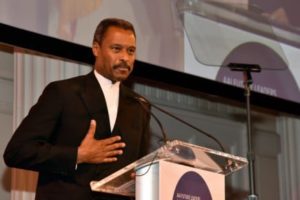
Morehouse President John Wilson said he expected Trump to sign an executive order increasing federal funding for HBCUs, as former President Obama did. Photo by Eugene Gologursky/Getty Images for The Africa-America Institute.
After spending two days in the nation’s capital meeting with President Donald Trump and key members of his administration, Morehouse College President John Wilson Jr. now says the “historic” sit-down with the president was nothing more than a photo op with “the African-Americans” at the White House.
In a less-than-enthusiastic statement released Thursday, March 2, Wilson acknowledged that, initially, he and the other 100+ HBCU leaders were excited to hear the Trump administration’s plans to show favor to the nation’s historically Black colleges and universities, specifically in the form of additional federal funding. He figured that since former President Obama had previously invested $3 billion in HBCUs during his first six years in office, surely President Trump would invest at least another $500 million in the financially strapped schools.
The disputed president has repeatedly pledged to “do more for HBCUs than any other president has done before,” so it was time to see if Trump would actually put his money where his mouth is.
“Besides the expectation of new funding, there was advance talk of changes like an aspirational goal of 5 to 10 percent for federal agency funding to HBCUs, a special HBCU innovation fund, large boosts in Pell Grant and Title III funding, and extra tax breaks for those in the private sector who contribute to HBCUs,” Wilson wrote.
To his disappointment, however, Wilson said rather than signing an executive order that would produce such outcomes, Trump merely moved the HBCU initiative from the Education Department to the Executive Office of the President. No additional funding. No tax breaks. Nada.
“It is not possible to measure the impact of this gesture anytime soon, if ever,” the HBCU president wrote.
Wilson then ripped into contested Education Secretary Betsy DeVos, who, during a special luncheon at the Library of Congress Feb. 28, suggested that historically Black colleges were created because “there were too many students in America who didn’t have equal access to education,” completely ignoring the fact that it ultimately was racist Jim Crow laws that kept Black students from receiving said education.
“HBCUs were not created because the four million newly freed Blacks were unhappy with the choices they had,” Wilson asserted. “They were created because they had no choices at all.
“That is not just a very important distinction, it is profoundly important,” he continued. “Why? Because if one does not understand the crippling and extended horrors of slavery, then how can one really understand the subsequent history and struggle of African-Americans or the current necessities and imperatives that grow out of that history and struggle?”
The Morehouse president wasn’t the only HBCU leader disappointed with last week’s meetings. Walter M. Kimbrough, president of Dillard University in New Orleans, also wrote a statement expressing frustration with the the way things went down, explaining that university leaders were initially told they’d be meeting with Secretary DeVos and a number of federal agencies but were instead ushered into the Oval Office to meet with Trump. Their plans of telling key government leaders more about the importance of HBCUs were essentially derailed.
“I’m still processing that entire experience,” Kimbrough wrote. “But, needless to say that [meeting with Trump] threw the day off and there was very little listening to HBCU presidents today. We were only given about two minutes each and that was cut to one minute, so only about seven of maybe 15 or so speakers were given an opportunity today.”
Only time will tell how committed the Trump administration is to helping HBCUs, according to Wilson. He called the meetings a “troubling start” to what was expected to be a productive relationship but said he and other HBCU leaders would continue pushing for the funding needed to help HBCUs succeed.
“Trust that the HBCU community will continue to press for the kind of funding that educational excellence and national competitiveness require!” he concluded.