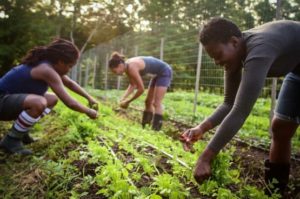
Image courtesy of YesMagazine.org.
When you think of a farmer, more often than not, you envision an aging white male tilling the soil on the sprawling acres of his farmland. The most recent USDA data show that of the nearly two million principal farm operators in the United States, just 6 percent are below the age of 35, while over 90 percent are white and more than 85 percent are male.
Over the past few years, however, the nation’s farming community has become increasingly diverse, with more and more young African-Americans trying their hands at agriculture. In fact, the number of Black-operated farms saw an impressive 20-percent jump between 2007 and 2012, according to the data.
So why are greater numbers of young Black Americans suddenly re-dedicating their lives to the soil? And why now?
The burgeoning generation of diverse and sustainable agriculturalists who attended the Young Farmers Conference, hosted by the Stone Barnes Center for Food and Agriculture last month, provided insight into why they chose to enter the world of farming and what it means for the future of food sustainability in America.
“In short, I farm because I would like fresh food and healthy food to be as accessible as doughnuts and junk food,” conference attendee Yemi Amu, who runs an aquaculture and hydroponics farm in Bushwick, Brooklyn, told Fusion. “[However], I’m worried that, even though I see the future of farming and healthy food as being accessible to everyone, it’s going in the opposite direction because people are not being paid livable wages and they can’t afford good food.”
Although various aspects of the farming industry have improved over time, former military service member Davon Goodman, 28, who owns and operates a diversified farm in Raeford, North Carolina, said he sees the industry going downhill if new, young farmers fail to replace the aging ones from the previous generation.
“If you don’t get a resurgence of young farmers before this last generation of old farmers dies out, then what’s next? What does it look like?” Goodman said. “To me, it looks like hell … less affordable food, a bigger hunger gap. The barriers to getting into farming are too big for most young people — capital, land, equipment, knowledge.”
The North Carolina man pointed out that although the USDA provides programs for young farmers like himself, sometimes it’s still not enough. Additionally, the hurdles blocking the way into farming are often harder to clear if you’re Black or nonwhite.
Black-owned farms are still few and far between these days, but it hasn’t always been that way. During the 1920s, the number of farms owned and operated by African-Americans peaked at nearly a million and accounted for 15 million acres of farmland, agricultural website Civil Eats reported. Back then, Black people made up 14 percent of the nation’s farmers.
But the pinnacle of Black farming didn’t last very long, as African-Americans were subjected to discrimination by the USDA, which refused to grant them farm loans. Factors such as the imposition of “tax sales, inaccessibility to legal counsel and exploitative land takings” also contributed to the sharp decline in Black-owned farms, according to Black Star News.
Today, African-Americans own just 7 million acres of farmland and account for less then 2 percent of U.S. farmers.
“It’s different being a Black farmer in the South,” Goodman said. “I get flack from both sides: African-Americans look at me and say, ‘Why would you want to farm? Why would you want to do this?’ And then, from whites, you get the power struggle. Land is very powerful and it has never really been in the hands of African-Americans on the large scale … and we haven’t gotten to the point where it’s sociable to be a Black farm owner.”
It’s also been “a struggle for me looking for land to expand my farm, because many white people don’t want to sell their land to a Black man,” he added. “The struggle is real.”
Twenty-four-year-old Willie Bradford, who runs a a cattle farm in Charleston, Mississippi, also admitted it’s a bit different being a Black farmer in the South. But, he acknowledged the power and benefits of farming and the advantages it provides to the Black community and beyond.
“People my color see a farmer and they think slavery,” Bradford told Fusion. “I try to tell them that it’s different now. There’s a lot of opportunity to be a small business owner, to feed your community and do a lot of great things.”


