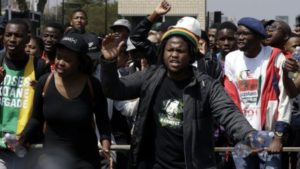
AP The protests come amid growing discontent with President Jacob Zuma’s government
South African police have fired stun grenades and arrested 31 students in Johannesburg, as a wave of protests hit universities across the country.
Students are demanding free education and denounced government plans to raise tuition fees by up to 8% in 2017.
Fees had been frozen last year after the biggest student protests since the end of apartheid in 1994.
The demonstrators say price increases discriminate against black students with low family incomes.
Africa Live: BBC news updates
#FeesMustFall: Stories behind the protests
The prestigious University of Witwatersrand in Johannesburg has been a focal point of protests.
It said about 200 students in “roving groups are moving from campus to campus disrupting classes”.
The University of Bloemfontein and the Nelson Mandela Metropolitan University in the coastal city of Port Elizabeth said they had closed campuses because of the protests.
The University of Cape Town announced the suspension of classes as students sang revolutionary songs barricaded entrances with litter bins.
University of Witwatersrand Students’ Representative Council leader Nompendulo Mkatshwa police fired stun grenades at students who had gathered near the university to protest against the proposed fee increase.
“Students are not happy with what the Department of Higher Education and Training said, so they are fighting for equal education,” Ms Mkatshwa is quoted by Reuters news agency as saying.
Police spokesman Lungelo Dlamini said the arrested students “were blocking the entrance of the university in contravention of the court order” and were being held at a nearby station, Reuters reports.
Last year, South Africa’s President Jacob Zuma froze student fees for 2016 following the worst student protests to hit South Africa since minority rule ended more than 20 years ago.
The freeze has now been lifted, with Higher Education Minister Blade Nzimande announcing on Monday that universities will be allowed to increase fees by a maximum of 8%.
Critics say this is higher than the 6% inflation rate, and will make university education unaffordable for many students.
However, universities favour an increase, saying they were facing a financial crisis which was damaging their academic programmes.
Read more here