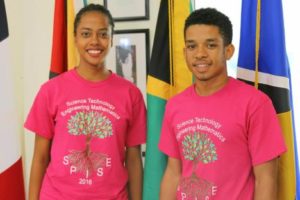
Arianna Stephenson (L) and Emmanuel Sylvester
BRIDGETOWN, Barbados — One month ago, 17-year-old Jamaican students Arianna Stephenson and Emmanuel Sylvester didn’t know much about building a wind turbine, or developing and programming an underwater robot. Today, not only can they do both of these things, but they can also program a computer game, and speak Mandarin.
That’s because Arianna and Emmanuel recently took part in the 2016 Student Program for Innovation in Science and Engineering, which ran from July 16 to Aug. 13 at the Cave Hill Campus of the University of the West Indies. Their participation was sponsored by the Caribbean Development Bank.
Now in its fifth year, the annual SPISE program, put on by the Caribbean Science Foundation, aims to groom the region’s next generation of leaders in science, technology and engineering. For one month, students from around the Caribbean are immersed in an intensive program of study, doing university-level courses in robotics, electronics, computer programming and Mandarin, among others.
“We’re very happy to once again support SPISE, as we believe that science, technology and engineering are critical to the Caribbean’s economic growth and development. Through this program, talented students from across the region are given the opportunity to develop their skills in a number of science, technology, engineering and mathematics areas. We hope that this will in turn encourage them to pursue careers in these areas, and by doing so, contribute to economic growth and development in the Caribbean,” said Yvette Lemonias-Seale, vice president, corporate services and bank secretary, CDB.
On Friday, Aug. 13, students got the opportunity to demonstrate to their parents, friends and sponsors what they had learned over the four weeks. As part of their final project presentations, students showed off their newly acquired Mandarin language and dance skills, presented computer games that they had developed and programmed themselves, and demoed wind turbines made out of PVC pipes, and robots that could move underwater.
For Sylvester, the SPISE experience gave him the opportunity to learn new skills.
“I’ve never done computer programming before and I thought that was a lot of fun. It wasn’t as hard as I thought it would be, but it was a lot of fun because when they gave you the problem and you can get your code to work that was a good feeling. I also enjoyed robotics; that’s something I’ve never done before either and I also learnt Mandarin for the first time,” he said.
Stephenson noted that SPISE has further cemented her love for science, and helped her to decide on possible future career prospects.
“I’m certain of science now… it has also inspired me to do something in biochemistry. I’ve never liked biology, but when I was learning ‘biochem’ I realized that this is so much more interesting!” she said.
SPISE is led by Professor Cardinal Warde of MIT, and is modeled after the well-known and highly successful Minority Introduction to Engineering and Science program at MIT, for which Warde has served as the faculty director for over 15 years. All post-PISE students also have the opportunity to be assisted with their college applications, and to participate in research internships in the Caribbean and abroad.
There were 19 participants in the 2016 program, hailing from Jamaica, Trinidad and Tobago, Barbados, St. Lucia, Dominica, St. Vincent and the Grenadines, Guyana and Martinique. It is the first time that a student from the French-speaking Caribbean has participated in the program.
Read more here.


