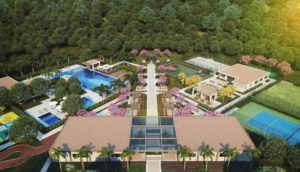
Image of the apartment complex that will be used to house journalists and other media professionals at the 2016 Rio Olympics. Image courtesy of Rio On Watch.
As journalists and media professionals head to Rio ahead of the 2016 Summer Olympics, many remain unaware that their lives are about to intersect with the dark slave past of Brazil.
According to Rio On Watch, the apartments that will be used to house journalists during the highly anticipated sporting competition were built using “labor in conditions analogous to slavery,” and reportedly constructed over top a sacred mass burial ground for enslaved Africans.
The land belongs to a group of people known as the quilombo, a federally recognized community comprised of the descendants of enslaved runaways. Officially designated as Barra Media Village 3, the newly constructed apartment complex was specifically built in Quilombo do Camorim, a community located near several Olympic venues in the West Zone of the city, Rio On Watch reports.
Quilombo Camorim leader Adilson Batista Almeida has accused developers of trampling the history of slavery in the area by ruining a number of archaeological remains near the site of an old sugar mill and taking away much needed land for the development of a public space that would be used to celebrate Afro-Brazilian culture.
“One Sunday morning a chainsaw came and devastated everything, including century-old trees,” Almeida said. “I regard the ground as sacred because it is where my ancestors were buried.”
According to The Guardian, the land was reportedly purchased in 2013 by real estate developer Cyrela, which felled hundreds of trees, dismantled a community football pitch and destroyed the remains of the old slave owner’s house and the slavery-era sugar mill so that the apartments could be constructed.
Going into the Olympics, many journalists, as well as the general public, remain unaware of the controversy, as major news networks have spent little to no time to covering the story. Holding the Olympic games in a country known for importing the largest number of enslaved Africans in the world is also a tough pill to swallow. Some would rather forget the history altogether.
But the quilombo serve as a reminder of Brazil’s dark history of slavery. Under Brazil’s modern constitution, quilombos are entitled to claim the lands their ancestors occupied, The Guardian reports. There are currently over 3,500 of these communities throughout Brazil, many of whom are still fighting to preserve their land and rich culture.
“I can say from my heart that I am proud to be part of a quilombo,” Almeida said. “Slavery was a time of great suffering for our ancestors, but we remember them not for the suffering, but for the struggle and resistance they went through to build this country.”
Late last year, the Cyrela real estate company found itself in hot water after the Public Ministry of Labor for Rio rescued 11 laborers from deplorable working conditions “analogous to slavery.” According to Rio on Watch, the workers charged with constructing the media village were provided accommodations that didn’t have any drinking water, was crawling with cockroaches and mold, and the only available bathroom had no shower and a toilet that didn’t flush.
The real estate developer “contracted out… the main activities of the company in an illegal way with the objective of circumventing worker’s rights to lower the costs of labor,” public prosecutor Guadalupe Couto said.
Cyrela was ultimately forced to pay each of the workers $20,000 as compensation, in addition to other fines, the publication states.
In an effort to reclaim what’s theirs, The Guardian reports that the quilombo have been working to acquire the title to land in the area near the old sugar mill for over a decade. However, the process to reclaim ownership was never finalized.
“Quilombo members haven’t yet made a final decision what land to claim, but in principle, they claim the land that is next to the church square, for cultural purposes,” read a 2009 report by the National Institute for Colonization and Agrarian Reform.
The Rio de Janeiro city government said it wasn’t aware of any claim made by the quilombo community, according to The Guardian.
Now forced to live with the media village built atop their ancestral burial ground, the quilombo have focused their efforts on constructing a community center on an adjacent, untouched piece of land. According to Almeida, the center will be built in honor of the community’s enslaved ancestors.
“Their blood that was spilled – I don’t want it to be in vain,” he said. “We want to fight for our space, our rights and our traditions so that our ancestors can look and see that today we are living in a better place.”


