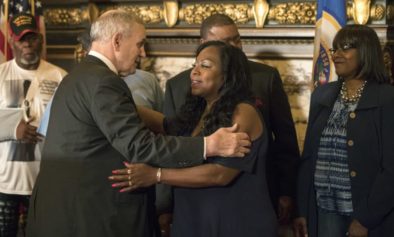
St. Anthony Police Department.
The St. Anthony Police Department in Minnesota has a history of disproportionate arrests for Black residents, a new analysis shows.
An examination of arrest and citation statistics for the agency has revealed that just this year close to half of all arrestees in the majority white suburb were African American, according to the Associated Press.
Officials released the data to the media this week in response to the national outrage spurred by the death of Philando Castile, who was shot and killed by St. Anthony officer Jeronimo Yanez during a traffic stop in Falcon Heights on July 6.
Castile’s girlfriend, who live streamed the aftermath on her cellphone, said the cop opened fire on the 32-year-old as he reached for his wallet to show identification.
Records showed that of the 994 arrests made by the department since January, 47 percent of the accused were Black while 46 percent were white.
Blacks make up only 7 percent of the populations of St. Anthony, Falcon Heights and Lauderdale combined, according to U.S. Census data.
“The data unfortunately shows that St. Anthony and Falcon Heights face many of the same challenges that Minneapolis, St. Paul and other communities are dealing with,” Mark Casey, St. Anthony city manager said in press statement, per Twin Cities Pioneer Press. “In light of the recent incidents, we have done additional review (of the data) and we do share concerns about the information and what it represents. Racial inequality, in terms of arrests and incarceration, is a complex yet urgent challenge for all of us.”
The news comes as reports surfaced that Castile had been pulled over by police at least 52 times in the last 14 years, resulting in 86 violations and $6,588 in fines and fees for mostly minor offenses.
The alarming figures are supported by a racial profiling report submitted to the Minnesota legislature in 2003, which found that law enforcement officials across the state stopped and searched African Americans drivers at higher rates than whites, yet were less likely to recover contraband from Blacks in those searches.
“There’s nothing that leads me to believe that anything there would be different,” University of Minnesota Professor Myron Orfield, who authored the report, told TIME magazine. “Maybe they’re worse.”
Although his study did not include data for the St. Anthony police department or Falcon Heights, Orfield said the region that encompasses the jurisdiction, had the largest racial disparity in traffic stops in the state.
The entire Minneapolis-St. Paul region has been plagued with racial disparities in employment, housing and education for decades.
In March of this year, Gov. Mark Dayton delivered a $100 million proposal to state legislators aimed at addressing the racial inequities. The Minneapolis NAACP, Black Lives Matter representatives and other civil rights and community-based organizations contributed ideas to the plan.
Recommendations included additional funding for the Minnesota Department of Human Rights, which fights workplace discrimination and diverting monetary resources into down-payment assistance programs for first-time home buyers with lower incomes, initiatives for unemployed youth, and programs that develop growth opportunities between and within businesses, according to the Star Tribune.