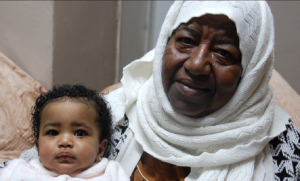
Zohra al-Qadi, member of African community in Jerusalem, holding one of her grandchildren (BBC)
The conflict between the Israelis and the Palestinians continues to take its toll, and in Jerusalem, Palestinians of African descent are among those most severely impacted by the cycle of violence.
Israeli security measures imposed last year are having a debilitating effect on the Muslim Quarter in Jerusalem’s Old City. And as The National reported, the city’s little known community of Afro-Palestinians have been hit the hardest, a group which faces double layers of racism as the further marginalized among an already oppressed group of Palestinians.
Afro-Palestinians live in a neighborhood next to Al Aqsa mosque, wedged between two Israeli police checkpoints through which only residents are allowed to pass. As a result, their shops, which sell clothing, souvenirs and snacks, are inaccessible to the worshipers who visit the mosque on a daily basis. The heightened Israeli security, restriction of movement of Palestinians, and humiliating treatment to which people are subjected, also deters many worshipers from coming in the first place. This is choking the local economy and forcing these Black Palestinians into poverty, in a Muslim Quarter where 35 percent of businesses have closed — and those remaining open have seen their sales drop by up to 80 percent. Residents reportedly live in fear of their safety, and two 12-year-olds were placed under house arrest for throwing stones at security cameras.
There are about 350 Afro-Palestinians in this section of Jerusalem, also known as the “African Quarter” according to the Times of Israel. Black people have lived in the city for centuries, and the African presence in Palestine dates back to the Islamic conquests, when Caliph Omar ibn al-Khattab conquered Jerusalem in 634, according to Al-Monitor.
The buildings they call home are 900-year old structures which became known as “The Blood Prison” a century ago, when the Ottoman Empire converted them into a prison for jailing and executing the condemned. Those who live there today are descended from Muslim pilgrims from Chad, Nigeria, Senegal and Sudan who came to Jerusalem and decided to stay. Their complex has grown into five apartment buildings, according to The National, and some of the Black Palestinians serve as volunteer guards to the mosque.
“Our contribution to the Palestinian national struggle gave us special status among Palestinians – we are accepted, well respected and I never felt discriminated against because of my color,” resident Ali Jiddah told The National.
Jiddah, now in his 60s, was a member of the Popular Front for the Liberation of Palestine, a leftist group, and spent 17 years in Israeli prison during the 1970s and 1980s.
Fatima Barnawi, another Afro-Palestinian, born to a Nigerian father and Palestinian mother, became the first Palestinian woman arrested on terrorism charges. Linked to an attempted bombing in 1967, the Fatah member was sentenced to 30 years in prison and went into exile after serving 10 years.
Meanwhile, as the Israeli public shifts ever rightward in its anti-Palestinian and xenophobic attitudes, people of African descent have borne the brunt of anti-immigrant violence. This has included the lynching of African immigrants and refugees, and even attacks on Jews of African descent by police, causing Ethiopian Israeli Jews to hold Black Lives Matter protests last year. Being Black and Palestinian makes the Afro-Palestinians particularly vulnerable.
“If you take our situation on the Israeli side, Palestinians are oppressed, but as Afro-Palestinians we are doubly-oppressed: as Palestinians and secondly because of our color. They call us ‘Kushi,’ which means n****r, or sambo,” Jiddah said. “Whenever there are political tensions between Palestinians and Israelis, the first sector to be affected by such measures is the Afro-Palestinians,” he added, also noting that in Jewish Israeli-owned businesses, Afro-Palestinians are the first to lose their jobs.
Yasser Qous, a man of Chadian descent who runs the African Community Society, said that most Afro-Palestinian Jerusalemites are regarded as “a bad group” by police, and many have served time in prison. He told the Times of Israel that his brother was arrested for being involved in political protests.
“What can we do? My brother’s been arrested 100 times. He’ll have 24 hours [in jail] and after that they will release him and he’ll do it again,” said Qous.
Afro-Palestinians also face racism from other Palestinians, as the Electronic Intifada reported, including some Palestinians from outside of Jerusalem who refer to the African community as the “neighborhood of slaves.” However, as Mahmoud Jiddah, one member of the community said, the Israeli police are the primary perpetrator of racism.