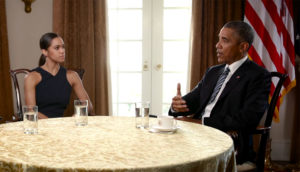
Image via Time Magazine
In an interview with TIME magazine, President Obama and ballerina Misty Copeland discussed the issues of being a minority in the country and the importance of being a role model for others.
Obama reveals that he did not believe his presidency — or his election to the White House — would put an end to the long-lasting effects of racism and bigotry in the nation. He stated in the interview:
“What I always try to transmit to my kids is that issues of race, discrimination, tragic history of slavery and Jim Crow, all those things are real … they didn’t stop overnight. Certainly not just when I was elected. I remember people talking about how somehow this was going to solve all our racial problems. I wasn’t one of those who subscribed to that notion. “
Many people in America, both black and white believed that Obama’s election meant we had made real racial progress, but the economic and political woes that have plagued the Black community before his election still continue. Even though Black unemployment fell to 8.3 percent in December, down sharply from 9.4 percent in November of last year, the Black community still suffers.
“Blacks still have higher unemployment than every other demographic. White unemployment is 4.5 percent, Hispanic unemployment is 6.3 percent and Asian unemployment is 4 percent,” CNN Money reported in January.
To add insult to injury, Black job seekers have allegedly been turned away because of “Black-sounding names.”
A recent study from The University of Chicago’s Marianne Bertrand and MIT’s Sendhil Mullainathan showed that a Black-sounding name can be an impediment. A sister study from National Bureau of Economic Research wrote about their findings in a paper entitled “Are Emily and Greg More Employable Than Lakisha and Jamal?”
The authors used the content of 500 real resumes for the experiment. Then they replaced the names with made-up names picked to “sound white” or “sound Black” and responded to 1,300 job ads in The Boston Globe and Chicago Tribune last year with those fake resumes. The authors found Black-sounding names were 50 percent less likely to get a callback than white-sounding names with comparable resumes.
Those are just two examples. Rampant gentrification, closing of DMVs and state mandated voter-ID laws that keep Black people from voting are issues that were not solved with Obama’s election — and may not be anytime soon.
The presidents’s quote is evermore significant because of the rise of Donald Trump and his wave of white resentment of Black and brown people.
Trump’s dominance in the 2016 presidential election proves that underprivileged whites were not too pleased to have a Black president. And that resentment and anger has manifested itself into violent altercations at rallies — where viral videos show angry white supporters brutally attacking Black, Latino and liberal protesters with the ferocity of wild animals. Senators Ted Cruz, Marco Rubio and Trump have blamed that violence on Obama.
Historically, when the nation tries to heal its racist wounds, there is a white backlash. Trump would not admit it, but he is at the center of that national white push back. Republicans have tried to pin this on the president.
“We’re working off of a legacy of hundreds of years of discrimination that gets passed on generationally,” the president said. “If we could decide tomorrow that there was no discrimination, that we had some new drug that everybody took and suddenly nobody would be racially prejudiced, we still have a whole bunch of really poor kids who need help.”
The president did not believe that his election would end racism because he realizes that it is impossible to undo hundreds of years of racial oppression and strife in a matter of two presidential terms. However, through the underlying principles of his speeches, he did believe that it was a step in the right direction.


