A new study indicates that Black unemployment remains high across the nation, with Washington, D.C. having the highest rate of joblessness among African-Americans nationwide. Examining a state-by-state breakdown of Black unemployment, the news is generally not good.
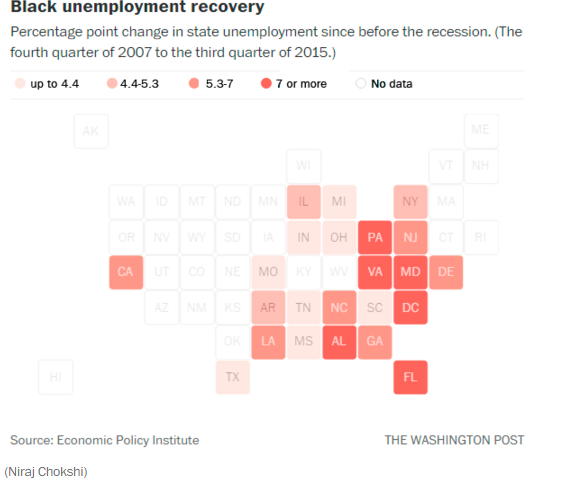
 A study by the Economic Policy Institute found that in the third quarter of 2015, unemployment was 5.1 percent, with African-Americans having the highest unemployment rate in the nation at 9.2 percent, followed by Latinos (6.4 percent), whites (4.4 percent), and Asians (3.6 percent). As the Washington Post reports, the leader in Black unemployment is Washington, D.C., with a rate of 13.6 percent, followed by Illinois at 13.3 percent, and Texas with 7.1 percent. In September, fifteen states had Black unemployment rates below 10 percent.
Further, the Black unemployment rate is more than twice the white rate in 20 of the 24 states examined. The largest racial gap was in the District of Columbia, where Black joblessness is 5.7 times more than whites, followed by Ohio and Illinois, each with Black unemployment rates exceeding white unemployment rates by a factor of 3.3.
 The state that is best for Black unemployment is Massachusetts, with a Black rate of 5.7 percent, though it is still 1.5 times greater than the white rate. Moreover, the Massachusetts labor force shrank by 1.8 percent between June and September, and a lower unemployment rate could have resulted from more job seekers giving up on their job search. Oddly, Massachusetts is the worst for Latino unemployment, while Washington, D.C., which is has the highest Black unemployment, has the lowest Latino rate of joblessness.
Recovery in Black unemployment is taking place in nine states—with pre-recession levels or below in six states (Indiana, Michigan, Mississippi, Ohio, Tennessee and Texas) and close in three additional states (Missouri, New York and South Carolina). However, it should be noted that with the exception of Texas, New York and Tennessee, these states had already suffered from some of the highest rates of pre-recession Black unemployment. Meanwhile, the worst state for Black unemployment recovery is Alabama, where the current level of 10.5 percent is nearly double its pre-recession rate.
 Typically, Black unemployment is far higher than the rate for white joblessness—double over recent decades— and the nation in general. Some potential reasons for this reality include systemic discrimination, racist hiring practices, and cuts to government jobs, which traditionally has been a sector where Blacks have been well represented. In addition, studies have shown that African-Americans with Black-sounding names face less of a chance of a callback for a job interview with white employers. As was reported by the National Journal last year, not only are Black college graduates twice as likely as other graduates to be unemployed, but white men with recent criminal backgrounds are much more likely to receive callbacks than Black men with no criminal record at all.
As the Huffington Post emphasizes, the official unemployment data are not comprehensive and do not tell the whole story. The figures do not account for those who are underemployed, working a part-time job and seeking full-time work, and those who have given up their job search altogether.