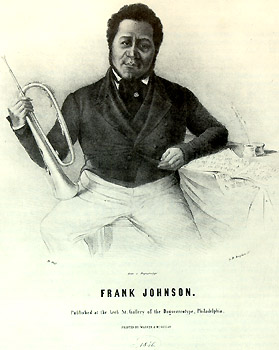
Francis Johnson
During the nearly 80 years now known as the Antebellum era of America (1781-1860), lived a man named Francis Johnson, commonly known as Frank. Of West Indian background, his American life began when he came to Philadelphia while still a teenager at the age of 17 in 1809.
As a teenager, he had an active role in leading musicians from teaching music, directing military bands and society dance orchestras. By the ’20s, he, with his band, performed at city functions like dancing schools, balls and private parties making a name for himself. Notable employers included The Washington Guards Company Three Band, the State Fencibles Regiment, The First Troop Philadelphia City Calvary, and famed resorts like Saratoga Springs and Cape May.
Johnson made a major contribution, early in his career to music by providing the majority of musical programming for General Lafayette’s return to Philadelphia in 1924. Playing between Philadelphia, New York and Boston over the next nine years, Johnson solidified his career as a musician while paving the way to writing his first composition in 1818, later published as, Collection of New Cotillions by George Willig in 1837 which brought him much acclaim.
From there, he took on assignments at major dance functions playing contemporary music of the time. His career continued to soar when in 1838, upon a trip to England, he and a consortium of African-American musicians – William Appo, Aaron J.R. Connor, Edward Roland and Francis Seymour – traveled to celebrate Queen Victoria taking the throne. Their band was the first American ensemble to make a tour abroad, making it a historic trip. While there, his exposure to promenade concert music changed his life and his music. His band toured England, played for Queen Victoria after which she gifted him with a silver bugle. With the aspiration of sharing concert music with the world, he brought it back to Philadelphia and its effect still survives in concerts settings, evidenced by the Boston Pops, now running for nearly 130 years.
Hometown success followed Johnson despite the racial era he lived in. His skill far surpassed trivial pursuits to focus on his cultural background – live performances often contained complex rhythmic changes.
The Philadelphia Public Ledger, which began publishing in 1836,
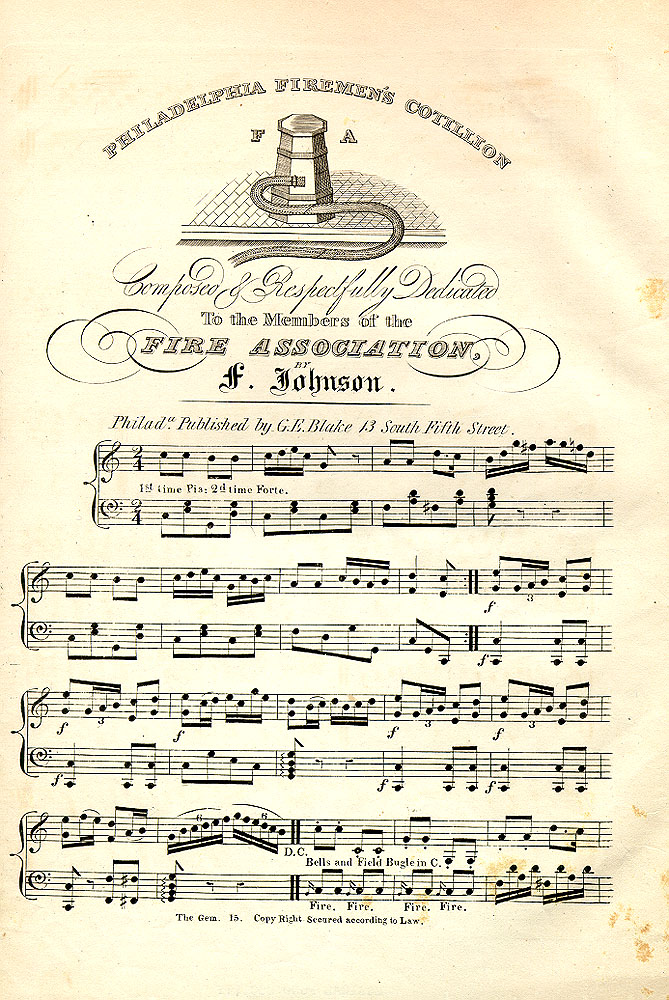
Philadelphia Firemens Orchestra.
noted during Johnson’s lifetime, he was an innovator in music, introducing the extended technique of singing while playing, commonly known today as an aid to creating harmonies by musicians using wind instruments. Some of his musical lines contained flute obbligato, which he used to mimic canaries in “Bird Waltz” – the imitated sound and the real were so close it was said to be imperceptible. This, along with dramatic effects and program music, became popular signatures of Johnson.
Today, Johnson’s music survives through limited printed materials: some manuscripts, piano transcriptions which were requested by publishers, skeleton guides, reviews from newspaper critics, musical programs and eyewitnesses – those in the audience who experienced his music. Further, his legacy lives as man of many firsts: first Black American composer to publish sheet music, first Black to gain fame in U.S. and England, first Black American to give formal band concerts and transcending color, the first American ensemble to tour abroad and the first musician to introduce promenade concert style to America and first Black American musician to play in integrated concerts in the U.S. as early as 1843.
His more than 200 compositions – operatic airs, Ethiopian minstrel songs, patriotic marches, ballads, cotillions, quadrilles and dances like quicksteps – are a testament to a life of his historic achievements and his undeniable impact as a pioneer of music and ensemble touring.


