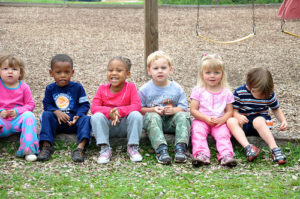
With Dearth of Quality Preschools in Black Community, $1B Preschool Investment Announced by Obama Could Be Big Help

Photo Credit:  bobkuehner via flickr

Photo Credit: bobkuehner via flickr

The dearth of affordable high-quality preschools is a huge issue in most African-American communities, so the $1 billion public/private investment in building more preschools announced yesterday by President Obama could be a big step toward helping more Black children succeed in school—and helping Black parents secure and sustain adequate employment.

With the federal initiative, the Education Department will give more than $226 million in grants to 18 states to enroll more than 33,000 youngsters in programs, while the Health and Human Services Department will give up to $500 million for Head Start and child care programs for more than 30,000 infants and toddlers.

In addition, the private sector has pledged more than $330 million to preschool projects, including $55 million from Walt Disney Co. and $25 million from the family foundation of J.B. Pritzker, a Chicago businessman whose sister is Commerce Secretary Penny Pritzker.

But Obama said that was not enough, calling on Congress to make more money available for programs. He pointed out major preschool initiatives in Republican-led states like Oklahoma and Georgia and said the federal government can help other states follow their lead.

“They’re not known as wild-eyed liberal states,” Obama said. “But it just goes to show you that this is an issue that’s bigger than politics.”

Researchers and education experts have long touted the benefits of high-quality preschool, particularly for African-American children and low-income children. A report last year from the Center for American Progress revealed how Black 4-year-olds enrolled in preschool programs in Tulsa and Boston made greater academic gains than their white peers.

African-American children in Tulsa made a 21 percent gain in problem-solving skills, compared to white children’s 6 percent gain, while making similar gains in literacy skills, according to the report. Black children in Boston also made stronger gains than their white classmates on three out of 13 developmental assessments.

 But more than half of African-American children ages three and four (and over 60 percent of Hispanic children) don’t attend preschool, according to the most recent data.
Overall, the United States ranks 28th in access to preschool among industrialized nations.
“Quite frankly, as a nation, we should be ashamed,” Education Secretary Arne Duncan told reporters at the president’s announcement.
Comparing the U.S. to countries in the European Union shows just how far the U.S. is behind the rest of the industrialized world. In the EU, pre-primary care for children ages 3 to 5 is close to universally available. But in the U.S., free education is generally available at least part-day for 5-year-olds, but in 2010 just 20 percent of 3-year-olds and 44 percent of 4-year-olds were enrolled in a public preschool program.
The consequences are especially dire for poor single mothers. Researchers estimate that on average, a poor mother spends 32 percent of her total weekly income on child care—a percentage that nearly doubles when more than one child needs care. This forces most single parents to turn to informal, cheap arrangements because so few public preschool slots are available. Since many jobs offering adequate pay require long and/or irregular hours, many single parents must resort to less well-trained or experienced child care providers who are working long hours or supervising too many children.

African-American single mothers and their children may experience the most adverse consequences of unemployment because their earnings constitute a greater percentage of their total family income. 

Still independent.

We hope this story was worth your time. For over 14 years, Atlanta Black Star has stayed Black-owned and independently run. We didn't get here by waiting on ad budgets that were never built to prioritize us. Our readers did that.

Corporate support for Black media has always been thin. Outlets like ours get roughly 1% of the $170 billion spent on U.S. advertising each year, and that margin is shrinking further as advertisers walk back the DEI-linked commitments they made in 2020. That's the backdrop. It's not why we're asking.

The wider picture isn't any steadier. Newspaper ad revenue has fallen more than 80% since 2005, and local newsrooms are closing at a rate of roughly two a week nationwide. When outlets go under, it's rarely the ones built to center a Black perspective from the ground up that get to stick around.

We know a request for support isn't why you came here. But without readers choosing to fund this work directly, the depth of reporting we can do at home and abroad shrinks along with everyone else's. If you're not in a position to give, that doesn't change how much we value you as a reader.

If you are able to, a recurring contribution does more for us than a single one-time gift, because it lets us plan the next investigation instead of just the next invoice. It takes about 30 seconds, no long form, no account. Thank you for continuing to support independent journalism and freedom of the press.

Back to top