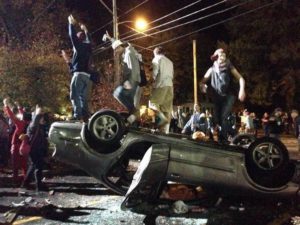
 Two days after Keene State College students rioted in New Hampshire during the town’s 24th annual pumpkin festival — toppling cars, tearing down signs and starting fires — a growing chorus of commentators in the African-American community have strongly noted the difference between the way the media portrayed the rioting college students and Black people in Ferguson, Missouri, protesting the killing of Michael Brown.
While the mayhem in New Hampshire was largely described as rowdy college kids having fun after too many drinks, there was a much more sinister tone to the descriptions of the actions of the Ferguson protesters, who were painted as lawless and intent on destruction and looting. The comparisons flew around social media and more probing websites.
“People were just throwing everything they could find — rocks, skateboards, buckets, pumpkins,” Keene State student Ellery Murray told The Boston Globe. “People just got too drunk.”
“It’s f*ckin’ wicked,” said 18-year-old Steven French. “It’s just like a rush. You’re revolting from the cops. It’s a blast to do things that you’re not supposed to do.”
But the coverage of the lawlessness on the campus, prompted by the community trying to set a world record for the largest number of carved and lighted jack-o-lanterns in one place, had a decided air of “oh those crazy kids.”
In contrast, a Missouri community expressing its sorrow and outrage over the death of one of their own, not to mention the everyday disrespect shown to the community by the Ferguson police, was covered by a media seemingly intent on chronicling every instance of looting or rock throwing — with a definite lack of empathy displayed over the community’s evident mourning and outrage over an 18-year-old being gunned down in its midst.
The cases were so fascinating because they provided the Black community with perfect props to point out the insidious racial bias of the American media.
“Of course in this country, New Hampshire pumpkins are something worth rioting over,” writer Kirsten West Savali noted with irony on damemagazine.com. “A dead Black child shot down in a hail of bullets and left to bake on a sweltering street for four hours, on the other hand, should be met with a peaceful response. Make note of that. Not once in the weeks of Ferguson protests, even with outside agitators attempting to spark unrest, did the level of destruction reach what occurred at the Keene Pumpkin Festival this weekend.”
Keene Fire Chief Mark Howard told New England Cable News that at least 30 people were injured near the school before Saturday evening, and 20 of them were taken to hospitals, while 12 people had been arrested.
“The kids at #keenestate threw beer cans at cops and got arrested. Mike Brown threw his hands up and caught SIX shots,” a user named Trademark noted on Twitter.
“How many of the defiant white youth causing mayhem & destruction come from fatherless families?” Kevin Gosztola asked in a tweet, while Brian Fleurantin said, “Where are the leaders in the white community? They need to speak out.” #pumpkinfest