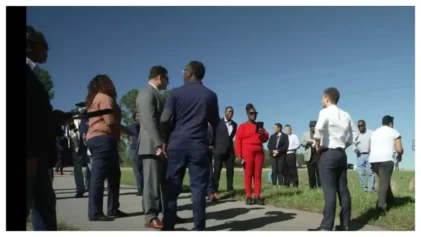
Holmes County, Mississippi
According to county residents, during the 1950s and 1960s, Holmes County, Mississippi, Chevy dealer, Norman Weathersby, then the only dealer in the area, required Black farmers to put up their land as security for small loans for farm equipment and pickup trucks.
Weathersby’s accomplice, William E. Strider, ran the local Farmers Home Administration — the credit lifeline for many Southern farmers. Area residents told the AP that Strider, now dead, often delayed releasing the operating loans to Blacks.
When cash-poor farmers missed payments owed to Weathersby, he took their land. The AP documented eight cases in which Weathersby acquired Black-owned farms this way. He died in 1973, leaving more than 700 acres of this land to his family, according to estate papers, deeds and court records retrieved by the AP.

Sweet Water, Alabama
In 1964, the state of Alabama sued Lemon Williams and Lawrence Hudson, claiming the cousins did not rightfully own two 40-acre farms their family had worked in Sweet Water, Alabama, for nearly a century.
The land, officials contended, belonged to the state. Circuit Judge Emmett F. Hildreth urged the state to drop its suit, declaring it would result in ”a severe injustice.” But when the state refused, saying it wanted income from timber on the land, the judge ruled in favor of the state.
The state’s internal memos and letters on the case are peppered with references to the family’s race. In the same courthouse where the case was heard, the AP located deeds and tax records documenting that the family had owned the land since an ancestor bought the property on Jan. 3, 1874. Surviving records also show the family paid property taxes on the farms from the mid-1950s until the land was taken.