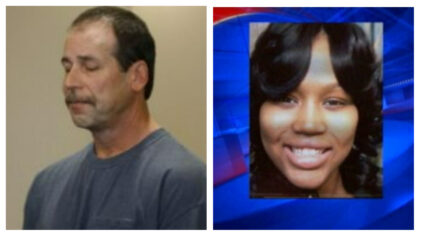
Wayne County Prosecutor Kym Worthy announced today that she was charging Theodore Paul Wafer, 54, with second-degree murder and manslaughter and a felony firearm charge in the controversial shooting death of Renisha McBride, 19, who apparently wandered onto his porch seeking help after a car accident.
While Wafer told police he killed McBride — whom Worthy described as “bleeding and disoriented” after a car crash — in self defense, Worthy disputed that notion.
“There is no duty to retreat when you’re in your own house,” Worthy said, quoting Michigan law. She said the person acting in self defense must believe their life is in danger.
“These are the appropriate charges and he did not act in lawful self-defense,” Worthy said.
Worthy asked that Wafer turn himself in before an arraignment scheduled for 2 p.m. CST.
There had been considerable anger and frustration in Detroit and across the country that Wafer had not been arrested nearly two weeks after he killed McBride on Nov. 2, prompting many observers to compare the case to George Zimmerman, who walked free for six weeks after killing unarmed 17-year-old Trayvon Martin.
But Worthy ultimately acted much more quickly than did prosecutors in Florida. Now will come the task of building a case and bringing it to trial.
Worthy’s job may have gotten more difficult with the news that a toxicology report released Wednesday shows McBride’s blood-alcohol content was roughly 0.22 percent – more than twice the .08 legal limit for driving in Michigan and eleven times the .02 legal limit for minors.
The report also shows that McBride had traces of marijuana in her system.
Some legal observers said the toxicology report might have an impact on the case and the suspect’s defense.
“Absent other factors, the fact that Miss McBride was drunk or high does not justify her death. Now, the shooter, on the other hand, may try to infer that Miss McBride was attempting to break into the house and her intoxication justified the shooter’s fear of a break in,” legal analyst Charlie Langton told CBS.
But Gerald Thurswell, the attorney representing McBride’s family, said to Crimesider that if McBride was intoxicated it “probably makes her less of a physical threat to anybody.”
“The bottom line in this whole case is that he was in his house, the door is locked, he has a phone,” Thurswell said. “All he had to do was call 911. Maybe she would have been arrested because she was drunk – but she’d be alive.”
Questioned by a reporter, Worthy said she did not believe Wafer was tested for drugs or alcohol at the time of the incident.
“She was found with a very large gunshot wound to the face,” Worthy said, and added that there were no signs of forced entry to the home.
While much has been made of the fact that McBride was Black and Wafer is white and lives in the predominantly white neighborhood of Dearborn Heights, Worthy, who is African-American, says that race is irrelevant.
“In this case, the charging decision has absolutely nothing to do with the race of the parties,” Worthy said.
According to reports, McBride hit a parked car with her own car sometime after midnight. Thurswell told Crimesider he has spoken with a woman who heard the car accident and came outside to offer help. The woman said that McBride seemed to have sustained minor injuries in the incident, was bleeding from the head, and kept saying “I want to go home.”